Spring Forward, Fall Back:
What Clock Changes Really Mean for Shift Workers
Every spring and autumn, the clock change quietly reshapes the length of night shifts. An hour disappears or appears, and suddenly a routine shift becomes shorter or longer than expected. This page explains exactly what happens, why it matters for fairness and pay, and the simple rule managers can use to keep everything consistent.
Twice a year the clocks play their little trick on us—one minute it’s 1:59, the next it’s… not.
For most people, this just means:
For most people, this just means:
- In spring: losing an hour’s sleep and grumbling into the first coffee of the day.
- In autumn: a glorious extra hour in bed and the annual battle with the car clock.
But if you work shifts, the clock change isn’t just an amusing quirk of the calendar—it can change the length of your working day.
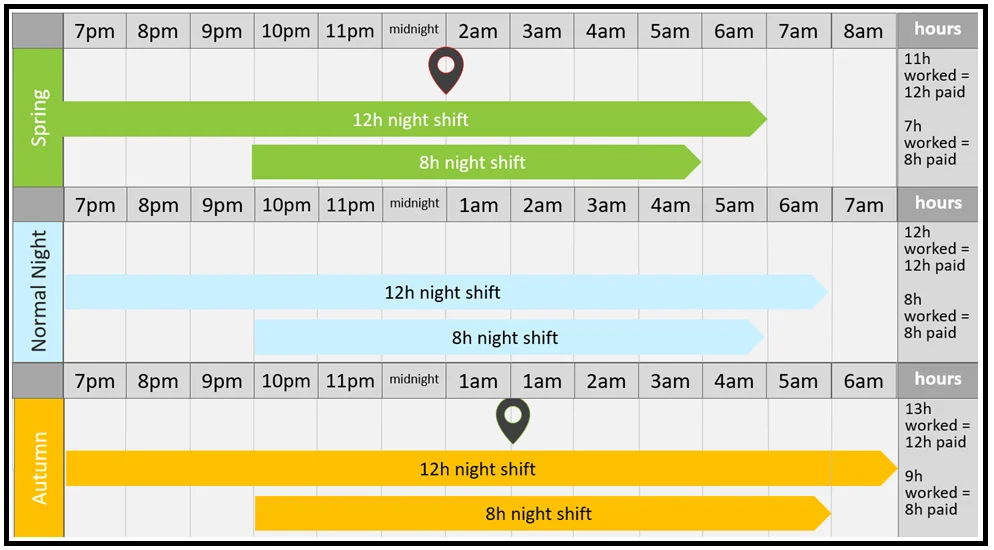
How clock changes affect night shift length and pay fairness across Spring Forward, Autumn Back, and normal nights.


What actually happens when the clocks change?
Spring: the “missing hour”
When we spring forward, the clocks jump from 01:00 to 02:00.
- On a night shift, that hour simply doesn’t exist.
- If your shift is, say, 22:00–06:00, it’s suddenly only 7 hours long in real time, even though on paper it still looks like 8.
For most people, this is invisible. For shift workers, it’s a shorter night that can cause confusion about pay, hours, and fairness if it’s not handled consistently.
Autumn: the “extra hour”
When we fall back, the clocks go from 02:00 back to 01:00.
- That means the hour between 01:00 and 02:00 happens twice.
- A 22:00–06:00 shift becomes 9 hours long in real time, even though it still looks like 8 on the rota.
So in autumn, anyone working over the clock change is effectively doing an extra hour.
Why this matters for shift workers
For shift workers, the clock change can mean:
- Longer or shorter shifts than usual, without it being obvious from the rota.
- Pay confusion if hours are calculated from clock times rather than actual time worked.
- Fairness questions—especially if some people always seem to land the “extra hour” shift.
It’s not just a technicality. If you’re already working nights, weekends, or rotating shifts, that extra hour can really be felt.

A simple, fair way for managers to handle it
You can make this painless and predictable with one clear rule:
- When clocks go back in autumn:
- Pay one extra hour of overtime (or equivalent) to anyone who works through the clock change.
- When clocks go forward in spring:
- Ignore the missing hour—treat the shift as normal, with no deduction.
This approach has a few big advantages:
- Fairness: Staff aren’t penalised for being rostered on an unlucky night.
- Simplicity: No complicated recalculations or fiddly timekeeping rules.
- Predictability: Everyone knows what to expect each year—no arguments, no surprises.
You can even write this into your local policy so it’s transparent and consistent.

Talking about it with your team
It’s worth making the clock change part of your regular rota conversations. For example:
- Before the change:
- Remind staff when the clocks change and what it means for their shift.
- Confirm how pay will be handled—especially for those on the night in question.
- On the rota:
- You might add a note like “Clock change shift—extra hour paid” in autumn.
- In spring, you can note “Clock change—no deduction of hour”.
A little communication goes a long way in avoiding “Hang on, why is my timesheet wrong?” emails.

And yes… the car clock
Of course, for many people the biggest drama is still:
Trying to remember how to change the clock on the car.
Pressing every button except the right one.
Giving up and deciding to mentally add or subtract an hour until October/March.
Shift workers get all of that plus the joy of working through the time warp itself.
Related Content
The ROI of Good Rotas:
Most organisations underestimate the power of a well‑designed rota. It’s not just a timetable — it’s one of the strongest financial levers in your operation. When shifts align with demand and fairness is built into the pattern, costs fall, turnover drops, and performance rises. Discover how good rota design delivers real ROI.
Trying to Replace Expertise with a Shift Pattern Generator:
Designing a shift pattern isn’t something you generate — it’s something you craft. Algorithms can produce combinations, but they can’t understand fatigue, fairness, wellbeing, or the lived reality of frontline work. Learn why expert shift design beats automated generators every time.
Operational Policy Framework:
Operational policies turn a rota into a reliable, fair, people‑centred operation. Without clear rules, even the best shift pattern becomes inconsistent, subjective, and vulnerable to conflict. Explore how a strong operational policy framework protects fairness and strengthens trust.
Hotel Management:
Hotels face a unique staffing challenge: employees want holidays during the busiest season, while occupancy fluctuates unpredictably. Events appear at short notice, guest behaviour is anything but linear, and staffing requirements shift week by week. See how hotel workforce planning can stay flexible, fair, and responsive.

A Spring forward, fall back policy should be part of your Operations Policies. It's an important part of your overall policy documents to ensure fairness throughout the year. For more information on our Operational Policy Framework click here.
Email: alec@visualrota.co.uk