Our Expertise
We specialise in designing fair, efficient and sustainable shift operations. With over 30 years of experience in mathematical modelling, operational research and real‑world consultancy, we help organisations create shift patterns that work for their people and their business.
Over 30 Years of Global Experience
Since 1996, we’ve been designing and delivering tailored workforce operations for organisations across the world. Our experience spans manufacturing, healthcare, logistics, hospitality, emergency services, public bodies and global corporate operations — each with its own pressures, constraints and culture.
Every project is different, and our depth of experience means we can quickly understand how your organisation works and adapt our methods to any industry, any scale and any operational challenge. Over the years we’ve helped teams move to fairer patterns, reduce fatigue, improve weekend balance, match staffing to workload, and implement new shift systems smoothly and confidently.
On this page, we share the core areas of expertise that underpin our work, including:
- Shift Pattern Design — creating fair, efficient and sustainable patterns that work for both people and operations.
- Workload Analysis & Demand Modelling — understanding when work happens so staffing levels match real demand.
- Fairness & Fatigue‑Friendly Design — balancing weekends, nights and recovery time to protect wellbeing.
- Migration Planning & Change Management — guiding organisations through the transition from old to new patterns.
- Training & Capability Building — equipping managers with the skills to run a successful shift operation.
- VisualrotaX Software Expertise — using our own software to design, manage and monitor shift patterns with clarity and confidence.
- Global, Cross‑Sector Experience — applying proven methods across industries, cultures and operational environments.
Together, these areas form the foundation of our approach: practical, evidence‑based and shaped by decades of real‑world experience.
Shift Pattern Design Expertise
Designing a shift pattern is far more than arranging people on a rota: it’s about creating a fair, efficient and sustainable way of working that supports both your people and your operation. With over 30 years of experience, we specialise in designing patterns that balance weekends, nights, fatigue, holidays, skills mix and real‑world workload.
We start by understanding how your organisation works: your staffing levels, terms and conditions, demand profile, culture and operational goals. From there, we design a pattern that gives you the right people at the right time, protects wellbeing and provides predictable, high‑quality time off.
If you’re exploring different options, our The Five Shift Patterns Every Organisation Should Know page explains the most popular 24/7 patterns: including the 2‑3‑2 (Panama) and 5‑5‑4 and why they work so well. For organisations wanting to understand the design process in more depth, our How to Create a Shift Pattern guide walks through the full methodology, from workload analysis to final rota.
Fairness is central to our approach. We design patterns that balance weekends and nights, distribute unpopular shifts evenly, and ensure holidays can be managed confidently. Our Holiday Management page explains about the different way we manage holidays on shift patterns so staffing levels remain safe all year round.
Whether you need a brand‑new pattern, a redesign of your current rota or a fairness review, our expertise ensures you get a pattern that works, for your people, your operation and your long‑term sustainability.
Different example shift patterns shown in VisualrotaX. Each of these patterns are for 24/7 operations.
Shift patterns shape everything: service levels, fatigue, morale, retention, and the long‑term sustainability of your operation. Yet many organisations still rely on inherited patterns, outdated templates, or “what we’ve always done” — even when those patterns no longer match demand or workforce expectations.
What problems a good shift pattern solves
A well‑designed shift pattern can fix:
- chronic understaffing
- unfair or uneven weekends
- excessive overtime
- fatigue and burnout
- holiday chaos
- mismatched skills on shifts
- firefighting and last‑minute cover
If you want to explore different shift pattern options, visit our Five Common Shift Patterns page.
Operational Diagnostics: Analysing & Diagnosing Operational Challenges
Understanding how an operation truly works requires more than looking at a rota or a set of KPIs. Our Operational Diagnostics process gets underneath the surface to identify the real causes of inefficiency, fatigue, staffing pressure and service‑level problems. We analyse how workload behaves, how staffing is deployed, how holidays and absences are managed, and how well the current shift pattern supports the organisation’s goals.
We combine mathematical modelling with real‑world operational insight to uncover patterns that are often invisible day‑to‑day: predictable workload spikes, chronic understaffing at key times, fairness issues, fatigue risks, skill‑mix gaps, and hidden sources of waste. This diagnostic work gives leaders clarity, not assumptions, about what needs to change and why.
Our analysis often includes:
- Workload profiling to understand when work actually happens
- Staffing vs demand comparisons to highlight gaps and over‑resourcing
- Fairness and fatigue assessments across weekends, nights and recovery time
- Holiday and absence impact analysis to identify pressure points
- Skills‑mix and team‑structure reviews
- Scenario modelling to test alternative patterns or staffing levels
These insights form the foundation for designing a fair, efficient and sustainable shift pattern. They also link directly to our other areas of expertise, including Shift Pattern Design, Workload Analysis, Holiday Management, and Migration Planning.
Operational Diagnostics is where every successful shift‑pattern project begins, with evidence, clarity and a deep understanding of how your operation really works.
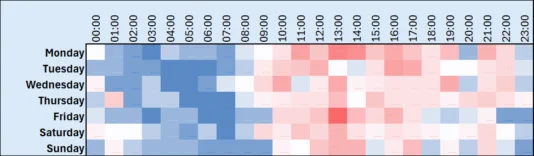
Typical weekly workload Demand‑Pressure Heatmap from real data. Showing that the workload is greater during the day (red/pink) and lower at night (blue/grey).
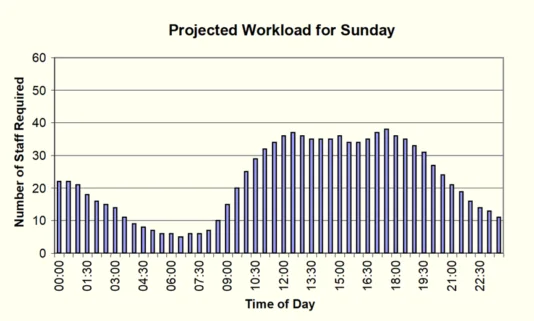
Typical daily workload pattern showing two demand peaks, one around midday and another early evening, with lower activity overnight. This highlights the challenge of matching staffing levels to real operational demand.
What This Graph Reveals About Workload vs Staffing
Workload rarely behaves in a straight line.
This graph shows a very typical daily pattern for any organisation that interacts with the public: the workload builds steadily from around 8am, reaches a peak around midday, dips slightly over lunch, rises again around 6pm, and then declines as most people go to bed. People can only contact a business when they are awake, so demand naturally follows human behaviour.
The challenge is that staffing levels cannot change every hour. You can’t send people home at 11am and bring them back at 1pm. You can’t roster staff in 45‑minute blocks. And you certainly can’t run an operation by constantly adjusting staffing minute‑by‑minute to match the curve.
So organisations face a fundamental decision:
- Do you staff to the peak and risk overstaffing for much of the day?
- Or do you staff to the average and risk understaffing at the busiest times?
Neither option is perfect and this is where expertise matters.
It’s also important to remember that this graph is an average. Averages can be extremely misleading. They smooth out the spikes, hide the extremes, and make the operation look far more stable than it really is. To understand what’s truly happening, you need far more than a single curve. You need:
- daily variation
- weekly patterns
- seasonal effects
- skill‑mix requirements
- holiday and absence impact
- real‑world operational constraints
This is at the heart of our expertise.
We don’t look at a graph like this and try to match staffing to it blindly. We dig into the truth behind the data, the patterns, the behaviours, the risks, the constraints and design shift systems that work for both people and operations.

Evidence‑Based Workforce Planning Rooted in Advanced Mathematical Modelling
Dr Angela Moore holds a PhD in mathematical modelling from the University of Southampton, specialising in modelling human behaviour in complex financial systems. This expertise translates directly into the world of workforce planning, where human behaviour is equally dynamic, unpredictable, and influenced by multiple competing pressures.
Using the same advanced modelling techniques, we analyse and predict patterns in:
- absence management
- holiday behaviour
- overtime trends
- variable staffing requirements
- operational bottlenecks
This allows us to design policies and shift systems that are not only fair and sustainable but also grounded in real behavioural data. Instead of relying on assumptions, we build models that reflect how people actually work — and how they are likely to respond to change.

Predictive Workload and Staffing Analysis
Our modelling goes far beyond headcount. We analyse workload patterns, skill requirements, and operational rhythms to determine exactly how many people you need, with the right skills, at the right times.
This ensures your organisation can:
- meet demand consistently
- maintain service quality
- protect staff wellbeing
- avoid unnecessary labour costs
- plan confidently around holidays and absences
We combine mathematical rigour with practical experience to create staffing solutions that are efficient, resilient, and cost‑effective

Designing Shift Operations That Balance Efficiency and Wellbeing
A shift pattern is never just a rota — it is the backbone of your operation. We design systems that consider:
- fatigue and recovery
- work/life balance
- fairness and transparency
- operational efficiency
- cost–benefit optimisation
This holistic approach means our clients receive shift operations that work for the business and the people who keep it running.
Real‑World Impact: Case Studies

Wedding Planners: Designing for Continuity and Revenue Growth
One of our most unusual — and rewarding — projects involved designing shift patterns for a team of wedding planners. At a successful venue, the planner assigned at the first consultation must be the same person who guides the couple through every meeting and is present on the wedding day. This continuity is not just about making the bride feel valued — it directly drives revenue.
The initial venue hire might be £1,000, but the full wedding package can reach £25,000 once the planner has built trust and introduced additional services such as entertainment, catering, flowers, fireworks, and bar packages.
The challenge? Weddings are often booked 12–18 months in advance. To guarantee continuity, the shift pattern must ensure that the same planner is available for every consultation, every planning milestone, and the wedding itself.
We created a tailored shift system that aligned planners’ availability with long‑term client journeys, ensuring continuity, maximising upsell opportunities, and protecting the venue’s reputation for exceptional service.

Global Operations: Follow‑the‑Sun Workforce Design
For international companies, we have created global shift operations that allow teams to work seamlessly across time zones. Using a follow‑the‑sun model, local teams handle daytime issues in their region while global specialists provide continuity and expertise.
This approach ensures:
- 24/7 coverage without excessive night work
- access to local language and cultural knowledge
- shared global expertise for complex issues
- resilience when one region faces disruption
It is a model that supports both operational excellence and employee wellbeing.
Food Manufacturing: Matching Staffing to Demand
In a 24/7 fresh‑food operation, demand fluctuates dramatically — especially at weekends. Supermarkets sell fewer products on Sundays, meaning the manufacturer needs fewer staff in production and warehousing.
We analysed the weekly demand curve and designed a shift pattern that aligned staffing levels with real workload. This reduced unnecessary labour on low‑demand days while ensuring full coverage during peak periods.
The result was a shift system that:
- matched staffing to demand
- improved efficiency
- reduced fatigue
- saved the company over 10% of its wage bill compared to flat staffing
This is the power of workload‑driven design.

Why Clients Choose Us
Organisations come to us because we combine:
- academic depth
- behavioural modelling
- operational experience
- global insight
- human‑centred design
We don’t offer generic templates. We create tailored shift operations that minimise cost, maximise efficiency, and support the people who make your business work.
Recommended Reading
Holiday Management
If you want to understand how annual leave interacts with staffing levels, fairness, and operational stability, start with the Holiday Management page. It explains the difference between Holidays Included and Holidays Excluded with a Holiday Management Plan, and shows how clear rules prevent conflict, reduce stress, and protect service levels.
Shift Pattern Design Cycle
To see how shift patterns are built from the ground up, explore the Shift Pattern Design Cycle. It explains how to analyse demand, build fairness into the structure, and create patterns that balance wellbeing with operational performance.
Operational Policy Framework
A shift pattern only works if the day‑to‑day operation supports it. The Operational Policy Framework shows how policies, procedures, communication pathways and governance turn a rota into a reliable, consistent system.
Banked Hours
If you want to understand how flexibility is built into the system, the Banked Hours page explains how banked time provides predictable cover, reduces costs, and gives staff more quality time off.
Managing Sickness & Short‑Notice Absence
Absence is one of the biggest sources of disruption in shift‑based operations. The Managing Sickness & Short‑Notice Absence page explains the direct and indirect costs of absence, why traditional reporting rules fail, and how a pre‑organised system prevents firefighting.
Business Health Check
If you want a complete view of your operation — shift patterns, policies, demand, staffing levels, absence, holidays and real‑world performance — the Business Health Check is the best place to start.