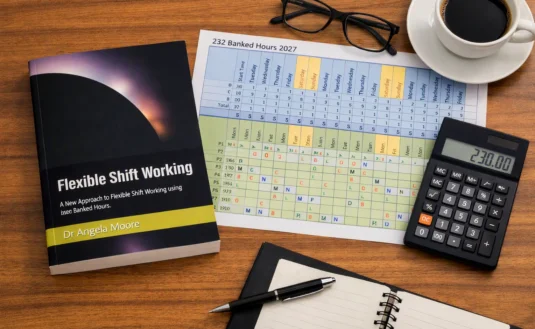
HowTo Banked Hours
A practical, step‑by‑step guide to setting up Banked Hours in your operation
Banked Hours is one of the simplest and most effective ways to give your operation flexibility while giving staff more predictable time off. It replaces overtime, firefighting and last‑minute rota changes with a calm, fair, transparent system that works across the whole year, not just week to week.
This guide gives you the core steps for setting up Banked Hours properly. For the full 136‑page method, including:
- Modelling,
- Fairness rules,
- Holiday integration
- Training with Banked Hours and
- Real‑world examples
What Banked Hours Are (in plain English)
Banked Hours means employees are paid in advance for a small number of hours they may work if the operation needs them. Typically:
- 90% of hours are scheduled
- 10% are banked
When demand increases, staff work from their bank. When demand is low, they take that time back as paid time off.
It’s simple, fair and predictable and when implemented properly, it transforms the relationship between staff and management.
But Banked Hours is more than just a clever scheduling tool. It’s a way to bring flexibility and security into shift work, two qualities that rarely coexist.
For most people, shift work feels rigid. The idea of flexibility seems alien: something that belongs to office staff who can choose when to work because timing doesn’t affect outcomes. Shift workers, by contrast, cover time‑dependent workloads. Being there when you’re needed can be a matter of life and death. That’s why shift operations have always been rigid: failings can be catastrophic.
However, rigidity can be just as catastrophic as flexibility. When every hour is locked into a fixed pattern, there’s no room to absorb the unexpected:
- Sickness,
- Surges in demand, or
- Personal emergencies.
Banked Hours changes that. It introduces a structured form of flexibility that protects both sides:
- For shift workers, it means guaranteed time off, predictable breaks, and the reassurance that flexibility doesn’t mean exploitation.
- For managers, it means guaranteed staffing levels when they’re needed most without relying on overtime or agency cover.
It’s not chaos; it’s controlled adaptability. It’s not about squeezing more work out of people, in fact it's the opposite; it’s about creating a system that works with human reality, not against it.
Banked Hours gives your operation the resilience it needs and your people the security they deserve. It’s flexibility with boundaries and that’s what makes it powerful.
Why Organisations Use Banked Hours
Banked Hours solves problems that traditional systems simply can’t:
- Reduces overtime and agency spend
- Provides predictable cover for busy periods
- Reduces stress on managers
- Improves fairness and transparency
- Supports wellbeing and work/life balance
- Helps avoid last‑minute rota changes
- Creates a calmer, more resilient operation
Why Overtime No Longer Works
Historically, companies relied on overtime to solve staffing gaps. Twenty years ago, overtime was popular, people wanted the extra money, and the tax system didn’t punish them for it.
But today, overtime has lost its appeal.
When workers are taxed at nearly 50p in the pound, the incentive to work harder disappears. People simply don’t want overtime anymore.
This leaves managers stuck:
they need flexibility, but staff aren’t willing to work extra hours.
Banked Hours solves this problem elegantly.
Who Can Use Banked Hours?
Banked Hours can be used by any team: office staff, hybrid workers, frontline teams, and 24/7 operations. But they are especially powerful for key workers, because these roles cannot simply be covered by “Joe Bloggs from the agency.”
Key workers often operate without direct supervision, especially at nights and weekends. They need to know:
- their job
- the operation
- the equipment
- the location
- how to cope alone when something unexpected happens
That level of competence takes time, training and experience. You can’t replace it with a temporary worker who doesn’t know the site, the risks or the procedures.
This is why Banked Hours is so valuable:
it allows you to bring in your own trained team when you need them, rather than relying on external cover.
It eliminates the need to train additional people.
It eliminates operational risk.
It keeps your operation safe.
Why Banked Hours Works for Modern Staff
Banked Hours isn’t about earning extra income. It’s about earning extra time off: paid time off.
Think of it as 50% extra holiday allowance, delivered in a structured, fair, predictable way.
For staff, this means:
- more rest
- more recovery
- more control
- more guaranteed time off
- less pressure to work overtime
For managers, it means:
- guaranteed staffing levels
- trained people available when needed
- reduced risk
- fewer last‑minute crises
- no reliance on agency cover
Banked Hours gives both sides what they need: security, flexibility and stability.
HowTo: Set Up Banked Hours in Your Operation
Below is a clear, five‑step process you can use to introduce Banked Hours safely and fairly.
Step 1: Define Your Base Hours
Start by confirming the contracted hours for each role or team. Banked Hours works best when:
- contracted hours are clear
- workload patterns are understood
- Uses of Banked Hours are clearly defined
This gives you a solid foundation for calculating the bank.
Step 2: Set Your Bank Percentage
Most organisations use about 10% of contracted hours as their bank. This gives enough flexibility to cover busy periods without overwhelming staff.
Examples:
- 40‑hour contract → 36 hours scheduled + 4 hours banked
- 37.5‑hour contract → 34 hours scheduled + 3.5 hours banked
- 46‑hour shift pattern → 42 hours scheduled + 4 hour banked
You can adjust this percentage if your workload is highly seasonal.
Step 3: Model Busy vs Quiet Weeks
Banked Hours is not about day‑to‑day tinkering: it’s about giving your operation flexibility across the whole year.
Model:
- peak weeks
- quiet weeks
- seasonal variation
- sickness patterns
- holiday clusters
- operational risk points
- Training requirements
This helps you understand when banked hours will be used and when they will be taken back.
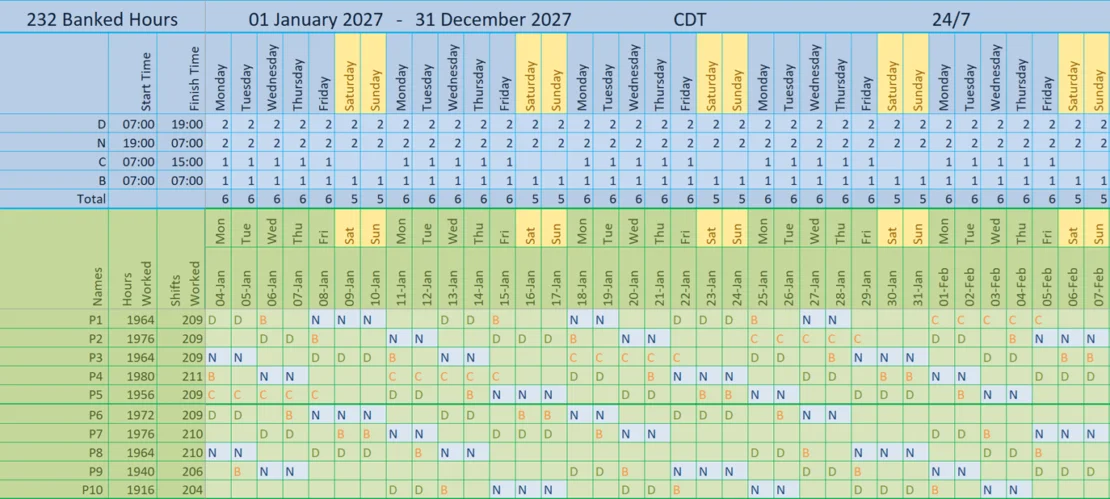
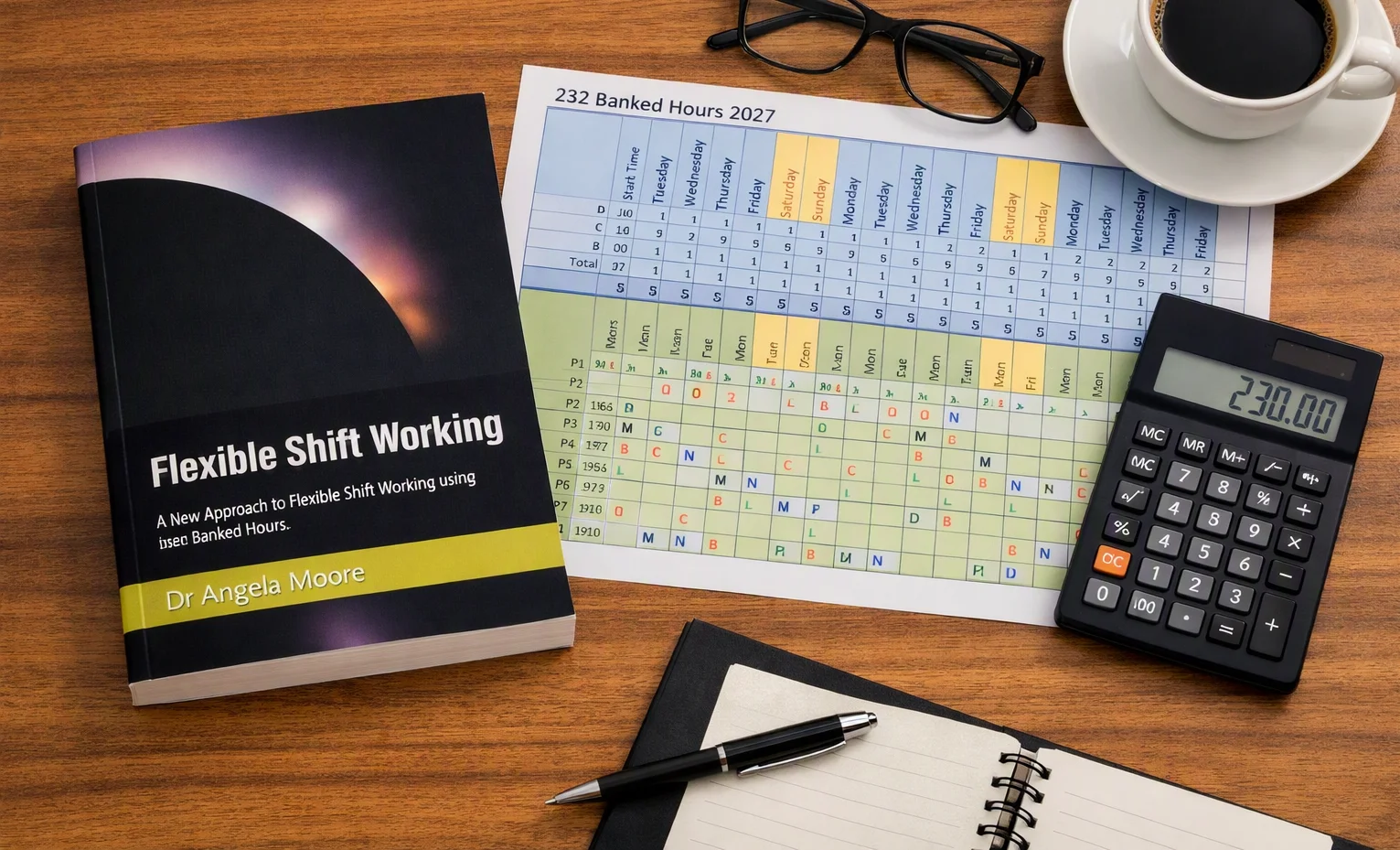
A real 232 Banked Hours rota demonstrating how trained staff can provide guaranteed cover while gaining five extra weeks of high‑quality time off each year.
Step 4 — Plan Long Breaks and Recovery
Banked Hours is not just about flexibility: it’s about creating high‑quality time off for staff while giving managers guaranteed cover. Long breaks are one of the most powerful outcomes of a well‑designed Banked Hours system, and the 232 pattern for 10 people is a perfect example of how this works in practice.
In this example, the team works a 33.6‑hour week on their regular Day and Night shifts. Every ten weeks, each person completes a week of Cover (C) shifts, which are 8‑hour shifts designed specifically for holiday cover. Because of the Cover week, their scheduled hours rise to 37.6 hours on an average week.
If staff are contracted for a 42‑hour working week, this means each person owes an average of 4.4 hours per week, or around 230 hours per year. These hours go into their Bank.
Because the shift pattern rolls over the year end, each person ends up with a slightly different total: typically between 210 and 274 hours in the Bank. This variation is normal and expected.
How Cover Shifts Work
Cover shifts are designed to make holiday planning simple and fair:
- A person on Cover can take that week off using 40 hours of holiday.
- Or they can book any other week off, and the person on Cover will cover their holiday shifts.
- When Cover shifts need extending from 8 hours to 12 hours, the extra 4 hours come from the Bank, not overtime.
This means holiday cover is guaranteed without relying on overtime or agency staff and without disrupting the rest of the team.
What B Shifts Are
Each person also has 36 B shifts across the year.
These are nominally zero‑hour shifts they simply mark the days when staff must be available to work their Banked Hours if needed.
In return for being available on these B shifts, each person receives five blocks of 10 days off across the year. You can see this clearly in the pattern: Person 10 is rostered off in the first block, then Person 9, and so on.
That’s five extra weeks off, in addition to their normal holiday allowance.
These long breaks are strategically placed to minimise disruption and maximise recovery.
Why Long Breaks Matter
Long breaks give shift workers:
- meaningful recovery time
- predictable rest periods
- stability across the year
- the ability to plan life outside work
- a sense of control and autonomy
And because shift workers are smart (they have to be, given the responsibility and independence their roles demand,) they quickly learn how to use the system to minimise disruption:
- booking holidays during Cover weeks
- extending their 10‑day Banked Hours breaks by adding a week of holiday
- swapping shifts to reduce the number of times they are called in
For example, using 24 hours of holiday to extend a Banked Hours break gives them 14 days off. This is one of the most powerful benefits of the system.
Why This Works for the Company
For managers, the benefit is simple and profound:
You know your trained, competent team will come in when you need them.
You don’t need to train extra people.
You don’t need agency cover.
You don’t need overtime.
You don’t need last‑minute firefighting.
You get guaranteed staffing levels with minimal risk.
Why This Works for Staff
For shift workers, the benefits are equally strong:
- stability
- guaranteed time off
- predictable long breaks
- flexibility to work how they want
- no pressure to work overtime
- paid time off instead of taxed overtime
It works for everyone as long as no one abuses the system.
Banked Hours Is Built on Trust
Banked Hours is powerful, but it is also fragile. If either managers or staff abuse the system, it collapses like a house of cards.
That’s why trust and fairness are the foundations of Banked Hours.
And that’s why Flexible Shift Working: A New Approach to Flexible Shift Working using Banked Hours is so important: it explains exactly how the system can be abused, from both sides and how to minimise the risks so Banked Hours remains stable, fair and effective.
Step 5: Track Balances Fairly
Tracking is essential.
You need a clear record of:
- hours worked into the bank
- hours taken back
- fairness across the team
- transparency of decisions
VisualrotaX handles this automatically: hours in, hours out, fairness and transparency.
If you track manually, ensure:
- balances are visible
- rules are clear
- no one is pressured to work extra
- time back is guaranteed
FAQ: Banked Hours
Banked Hours are planned, predictable, and fair.
Overtime and TOIL are reactive, inconsistent, and often unfair.
With overtime, staff work extra hours after the need arises, usually at short notice, often when they’re already tired, and at a financial cost to the organisation. TOIL is even less reliable, because it depends on managers remembering to give time back and staff being able to take it.
Banked Hours flips the system on its head. Staff are paid in advance for a small number of hours they may work if the operation needs them. When demand is low, they take that time back as paid time off. It’s structured flexibility, not last‑minute firefighting.
Overtime and TOIL are reactive, inconsistent, and often unfair.
With overtime, staff work extra hours after the need arises, usually at short notice, often when they’re already tired, and at a financial cost to the organisation. TOIL is even less reliable, because it depends on managers remembering to give time back and staff being able to take it.
Banked Hours flips the system on its head. Staff are paid in advance for a small number of hours they may work if the operation needs them. When demand is low, they take that time back as paid time off. It’s structured flexibility, not last‑minute firefighting.
It depends entirely on what you want Banked Hours to achieve, but around 10% is typical for most operations.
Here are a few examples:
Training: ~1%
Absence cover: ~3%
Peak workloads / seasonal variation: ~6%
Add these together and you get a sensible, balanced 10% Banked Hours system that supports training, resilience, and workload variation without overwhelming staff.
Here are a few examples:
Training: ~1%
Absence cover: ~3%
Peak workloads / seasonal variation: ~6%
Add these together and you get a sensible, balanced 10% Banked Hours system that supports training, resilience, and workload variation without overwhelming staff.
Tracking Banked Hours fairly is extremely difficult without software designed specifically for shift workers.
Most HR systems treat Banked Hours as an “add‑on”, which leads to errors, unfairness, and mistrust.
Fortunately, VisualrotaX was built from the ground up to manage Banked Hours properly. It:
tracks hours in and out
handles B‑shifts and cover shifts
integrates holidays and absences
ensures fairness across the team
works alongside your existing software
And it starts at £99, making it one of the most cost‑effective ways to run a safe, transparent Banked Hours system. VisualrotaX was designed while running a real 24/7 operation and later became the foundation of our consultancy. It’s used worldwide because it works.
Most HR systems treat Banked Hours as an “add‑on”, which leads to errors, unfairness, and mistrust.
Fortunately, VisualrotaX was built from the ground up to manage Banked Hours properly. It:
tracks hours in and out
handles B‑shifts and cover shifts
integrates holidays and absences
ensures fairness across the team
works alongside your existing software
And it starts at £99, making it one of the most cost‑effective ways to run a safe, transparent Banked Hours system. VisualrotaX was designed while running a real 24/7 operation and later became the foundation of our consultancy. It’s used worldwide because it works.
This is a very important question and one of the reasons you need a copy of Flexible Shift Working, because it explains the process in detail.
In simple terms, you calculate:
the hours they have worked
the holidays they have taken
their contracted hours
Then you treat Banked Hours exactly the same way you treat holidays when someone leaves. If they owe hours, it is deducted. If the organisation owes them hours, it is paid or credited appropriately.
The key is having a clear policy and accurate tracking, which is why the book covers this topic thoroughly.
In simple terms, you calculate:
the hours they have worked
the holidays they have taken
their contracted hours
Then you treat Banked Hours exactly the same way you treat holidays when someone leaves. If they owe hours, it is deducted. If the organisation owes them hours, it is paid or credited appropriately.
The key is having a clear policy and accurate tracking, which is why the book covers this topic thoroughly.
Training is one of the primary uses of Banked Hours.
Shift workers are notoriously difficult to train because their working hours rarely align with training schedules. Early starts, late finishes, and 12‑hour shifts make traditional training almost impossible, staff are either exhausted or unavailable.
Banked Hours solves this completely.
You allocate a set number of Banked Hours to training at the start of the year. Staff then attend training on a B‑shift, working exactly the length of the training course. This:
minimises fatigue
maximises learning
guarantees attendance
ensures fairness
eliminates disruption to the rota
It is one of the most powerful and practical uses of Banked Hours.
Shift workers are notoriously difficult to train because their working hours rarely align with training schedules. Early starts, late finishes, and 12‑hour shifts make traditional training almost impossible, staff are either exhausted or unavailable.
Banked Hours solves this completely.
You allocate a set number of Banked Hours to training at the start of the year. Staff then attend training on a B‑shift, working exactly the length of the training course. This:
minimises fatigue
maximises learning
guarantees attendance
ensures fairness
eliminates disruption to the rota
It is one of the most powerful and practical uses of Banked Hours.
Flexible working increases productivity because you only bring staff in when you actually need them. Why pay highly trained people to stand around “just in case”? It’s expensive, wasteful, and demoralising.
Banked Hours gives staff more time off in return for being available when needed. This means:
fewer unnecessary shifts
fewer idle hours
fewer overtime requests
better alignment with workload
lower costs
higher morale
It’s a genuine win‑win: the organisation saves money, and staff gain meaningful time off.
Banked Hours gives staff more time off in return for being available when needed. This means:
fewer unnecessary shifts
fewer idle hours
fewer overtime requests
better alignment with workload
lower costs
higher morale
It’s a genuine win‑win: the organisation saves money, and staff gain meaningful time off.
Flexible Shift Working is the complete guide to designing, running, and safeguarding a Banked Hours system. It covers:
what Banked Hours are
how to create them
how to calculate them
how to use them for training
how they interact with absences
how cover shifts work
how to extend shifts safely
how to manage excess hours
how to build flexible capacity
how to prevent abuse
how to negotiate with unions
how office workers can use Banked Hours too
what really happens in practice
If you are going to run a Banked Hours operation or are even considering one, you need this book. It explains everything that can go right, everything that can go wrong, and how to make your system safe, fair and effective. And at only £10, it’s the most cost‑effective operational manual you will ever buy.
what Banked Hours are
how to create them
how to calculate them
how to use them for training
how they interact with absences
how cover shifts work
how to extend shifts safely
how to manage excess hours
how to build flexible capacity
how to prevent abuse
how to negotiate with unions
how office workers can use Banked Hours too
what really happens in practice
If you are going to run a Banked Hours operation or are even considering one, you need this book. It explains everything that can go right, everything that can go wrong, and how to make your system safe, fair and effective. And at only £10, it’s the most cost‑effective operational manual you will ever buy.
Common Mistakes to Avoid
Banked Hours only works when implemented properly.
Avoid:
- using banked hours as disguised overtime
- failing to give time back
- unclear rules
- unfair distribution
- tracking balances inconsistently
- ignoring seasonal workload patterns
These mistakes undermine trust and fairness.
Flexible Shift Working
Flexible Shift Working is the essential guide for anyone planning to introduce, manage or improve a Banked Hours system. If you run a shift operation: whether in healthcare, manufacturing, security, hospitality, engineering or any 24/7 environment, this book is the difference between a system that works beautifully and one that collapses under pressure.
Across 136 pages, Dr Angela Moore explains exactly how Banked Hours work in practice, how to calculate them, how to use them safely, and how to avoid the pitfalls that cause most flexible‑working schemes to fail. It is practical, clear, and grounded in real operations.
Inside, you’ll learn:
- What Banked Hours are and how they create flexibility and security
- How to calculate Banked Hours accurately for any shift pattern
- How to create Banked Hours from scratch — step‑by‑step
- How to use Banked Hours for training, development and skill coverage
- How Banked Hours interact with absence, holiday cover and long breaks
- What really happens in practice when Banked Hours are introduced
- How cover shifts work, and how to design them fairly
- All the uses of Banked Hours — from extending shifts to flexible capacity
- The benefits for staff and managers, including stability, wellbeing and guaranteed cover
- How volunteering for Banked Hours works, and how to keep it fair
- How to handle excess hours, productivity changes and sent‑home rules
- How to negotiate Banked Hours with unions
- How office workers can use Banked Hours too
- The abuses you must protect against — from both managers and staff
- How to build trust, the foundation of every successful Banked Hours system
This book doesn’t just tell you what to do. It tells you why, how, and what happens if you get it wrong. It is the only resource that explains the full system, including the human, mathematical and operational sides of Banked Hours.
If you are going to run a Banked Hours operation or are even considering one, you need this book. It will save you time, money, stress, and countless operational problems. And at only £10, it is the most cost‑effective way to ensure your Banked Hours system is safe, fair and successful.
Next Steps & Related Pages
To deepen your understanding of Banked Hours and how they fit into wider operational design, explore these related pages. Each one expands on a different part of the system.
🕒 Banked Hours
A full introduction to Banked Hours, including how they work, why they outperform overtime and TOIL, and how they create flexibility and security for both staff and managers.
This page also links to our Banked Hours video course and our books, including Flexible Shift Working and How to Manage Your Shift Pattern: Holidays and Absences.
🌴 Holiday Management Plan
A practical guide to building a fair, transparent holiday system that works with any shift pattern.
Covers annual leave rules, fairness modelling, peak‑period planning, and how Banked Hours integrates with holiday cover.
🚑 Absence Management
Explains how to manage sickness and absence fairly while protecting operational stability.
Includes absence triggers, risk modelling, and how Banked Hours supports resilience during periods of uncertainty.
📅 Holiday Management in Shift Patterns
Shows how holidays interact with different rota structures, including 232, DuPont, 4on4off, 554 and 8‑hour patterns.
Ideal for understanding how Banked Hours and holiday cover work together in real operations.
🎓 Training
Details our Shift Pattern Training Programme, including Banked Hours, holiday planning, absence management, fairness modelling and operational stability.
Training is tailored to your operation, your workload and your challenges.
🔄 Five Shift Patterns
A clear explanation of the five most widely used 24/7 patterns:
232 (Panama), DuPont, 4on4off, 554 and the 8‑hour 232.
Shows how each pattern works, when to use it, and how Banked Hours can be integrated.