Holiday Management Plan & Holiday Included Shift Patterns
Managing holidays in a shift‑based operation is one of the biggest hidden challenges for any organisation. Whether you run a 24/7 operation or a small team with specialist skills, holiday planning affects staffing levels, productivity, overtime, wellbeing and operational stability. There are two proven approaches: Holidays Included Shift Patterns and Holidays Excluded patterns supported by a Holiday Management Plan. This guide explains both, helping you choose the right approach for your organisation.
Why Holiday Management Is So Difficult
Holiday planning seems simple until you look at the numbers.
Even in a small office‑hours team of 10 people, each with six weeks of holiday, you must fit 60 weeks of holiday into a 52‑week year. That means at least one person must be off every day. That is before you even consider sickness, training or unexpected absences.
In shift operations, the challenge is even greater:
- specialist skills must be covered
- minimum staffing levels must be maintained
- holidays cluster around summer and Christmas
- managers spend huge amounts of time processing requests
- last‑minute changes disrupt both the operation and employees’ lives
Without a structured approach, holiday management becomes reactive, stressful and expensive.

When holidays aren’t planned, managers end up firefighting: juggling requests, fixing gaps and absorbing the stress.
The True Cost of Poor Holiday Planning
Poorly managed holidays create several hidden costs:
- Overtime — covering gaps at short notice
- Lost productivity — when key skills are missing
- Under‑utilised equipment — when staffing drops below safe levels
- Manager time — spent processing requests and reorganising work
- Employee frustration — when holidays clash or are denied
- End‑of‑year panic — when staff still have weeks of holiday left
A good system reduces all of these pressures.
Two Approaches to Holiday Management
There are two main ways to manage holidays in shift operations, and each one solves the problem in a very different way.
Holidays Included Shift Patterns
In this approach, all holiday entitlement is built directly into the shift pattern itself. Staff receive their time off automatically through the rota, without needing to request dates. This creates a highly predictable, fair system with minimal management involvement and almost no holiday clashes.
Holidays Excluded Shift Patterns with a Holiday Management Plan
Most organisations allow staff to choose their own holiday dates. This offers flexibility, but without a plan it quickly becomes chaotic, especially in summer. A Holiday Management Plan sets clear rules on how many people can be off, when requests can be made, and how holiday cover is organised, creating stability and fairness.
Both approaches work well, but they suit different types of organisations depending on how much flexibility, predictability and management involvement is required.
Example: Holidays Excluded vs Holidays Included in a 24/7 Operation
To show the difference a structured approach makes, let’s look at a real example. This operation runs 24/7 with 14 people, staffing three on Days, three on Nights, plus one cover person.
Holidays Excluded with no plan: the staffing levels should be three on D (day) shift and three on N (night) shift. Instead because holidays are taken without a plan, there is some times zero in and sometimes four. The absences are caused by holidays and sickness. There was one cover shift (C) on each day, but it is not always being utilised because no one is sick and no one wants a holiday.
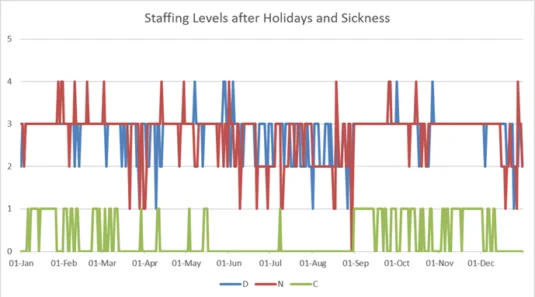
Daily staffing levels with Holidays Excluded: frequent shortages, unpredictable cover and constant firefighting for the manager.
Holidays Included: The staffing levels on a holidays included shift pattern are far more predictable. Each shift, the only disruption is sickness. This is far smaller than holidays and sickness. The holidays are spread out over the year. Most of the shifts will be correctly staffed.
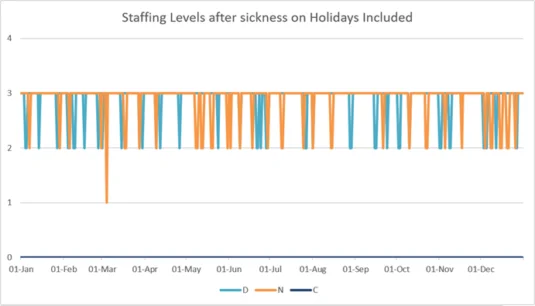
Daily staffing levels with Holidays Included: stable, predictable staffing all year, with holidays fully built into the shift pattern.
Holidays Excluded (No Plan): What Happens in Reality
When holidays are unmanaged and staff choose their own dates, the year becomes unpredictable:
- Some days have more people than needed because staff take holiday on a night shift, but the cover person is still required to work the following night shift.
- Most days have fewer people than required, leaving the manager scrambling to fill gaps.
- The cover person is constantly being pulled into nights or days at short notice.
- Staff naturally cluster holidays around summer and Christmas, creating sudden staffing drops.
- At the end of the year, several people still have holiday left — which then gets rolled over, making the following year even harder.
- Every day is different, and the manager spends the year firefighting.
Across the year, this operation experienced 20% of shifts where staffing fell below the minimum level needed to run safely.
Holidays Included: The Same Operation, But Stable
Now take the same 14 people, the same workload, and the same 24/7 pattern — but use a Holidays Included Shift Pattern.
Here’s what changes:
- The cover person is rostered off for one week or 10 days at a time throughout the year.
- In summer, they receive two full weeks (17 days) off, giving them predictable, high‑quality time away.
- Everyone knows exactly when their holidays are, months or years in advance.
- The manager only has to deal with sickness, not holiday chaos.
- Staffing levels remain stable and predictable every week of the year.
- No holiday is carried over — everyone gets their full entitlement automatically.
With holidays included, the operation achieved 90% of shifts with the correct staffing level. This is a dramatic improvement.
These two graphs opposite show the same 14‑person 24/7 operation. The first with unmanaged holidays, then with holidays included and the dramatic difference in staffing stability.
Same People, Same Workload
The only difference is the system.
- Holidays Excluded with no plan = chaos, firefighting, unpredictable staffing, overtime, and end‑of‑year holiday backlogs.
- Holidays Included = stability, fairness, predictable staffing, and minimal management effort.
The 232 shift pattern or (Panama) using 12-hour shifts, expanded for five weeks. This is a holidays included version using five teams of three. Each week one of the teams is rostered off for 10-days. This is a combination of holidays and rest days. Therefore they would have ten weeks of holiday per year on this shift pattern. Most holidays included shift patterns have a special summer period where they get a two-week break. It is shown in VisualrotaX, so you can see exactly how many people are rostered on each day. It is a five week repeating shift pattern so over the five weeks they all work the same number of shifts, hours, weekends, days and nights.
For more information on the 232 shift pattern click here
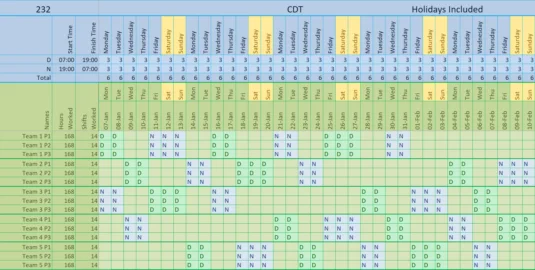
Visual diagram of the Panama 232 shift pattern, displaying the rotating sequence of two or three day shifts, two or three night shifts and rest days that provide 24/7 staffing with built‑in 10-day holiday breaks.
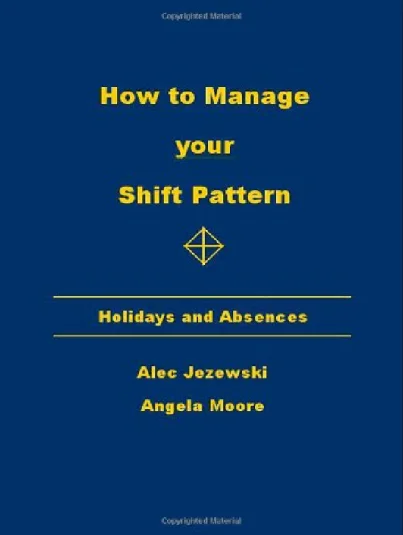
A practical book on shift pattern design, holiday management and rota planning. That shows managers how to run and maintain a fair, efficient shift pattern including: holidays, absences, staffing levels and day‑to‑day management.

Holidays Included Shift Patterns
Holidays Included Shift Patterns build all holiday entitlement directly into the shift pattern itself. Staff receive their full annual leave automatically through the rota, without needing to request dates.
Benefits
- Minimal management involvement
- Highly predictable staffing levels
- Fair, regular time off for everyone
- No holiday clashes
- No end‑of‑year holiday panic
- Very low overtime risk
This approach is used by groups such as teachers, emergency services and some 24/7 operations where stability and fairness are essential. For an unusual case study into holidays included, click here to read about Holidays Included and Wedding Planners.
Who it’s best for
- Operations needing consistent staffing
- Teams with specialist skills
- Environments where fairness and predictability matter
- Organisations wanting to eliminate holiday admin entirely
If you’d like to explore this approach in depth, see our book How to Manage Your Shift Pattern: Holidays and Absences on Amazon. There are lots of examples of holidays included shift patterns written out for the full year.
The 4on-4off shift pattern or Continental using 12-hour shifts, expanded for 20-days. This is a holidays included version using five teams of three. This is a 10-day repeating pattern where they would two days, two nights and than have six days off. The six-days off are a combination of holidays and rest days. Therefore they would have 36 breaks of six days in a year on this shift pattern. It is shown in VisualrotaX, so you can see exactly how many people are rostered on each day. Over the 20 days, everyone gets two 6-day breaks and everyone works the same number of shifts, hours, days and nights.
For more information on the 4on-4off shift pattern Click Here
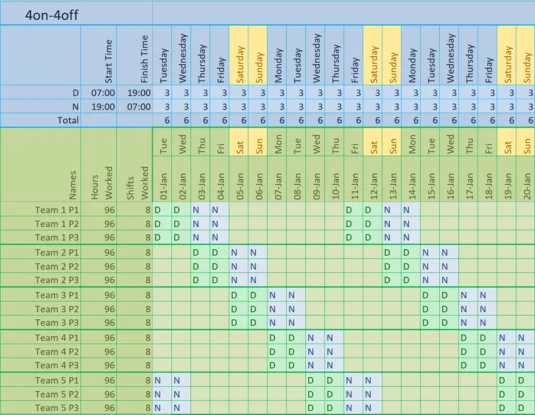
Diagram showing the 4-on-4-off or Continental shift pattern, with four consecutive 12‑hour shifts followed by six days of rest and holidays, providing simple, predictable 24/7 coverage.
Holidays Excluded Shift Patterns (with a Holiday Management Plan)
Most organisations use a Holidays Excluded pattern, where staff choose their own holiday dates. This offers flexibility but without a plan, it quickly becomes chaotic.

Holiday Request Flow Diagram demonstrates how a Holiday Management Plan can be used to assist employees with picking their holidays.
Benefits
- Flexible for staff
- Predictable for managers
- Reduces overtime
- Fair and transparent
- Works with any shift pattern
A Holiday Management Plan provides structure and fairness by:
- setting limits on how many people can be off per shift
- defining when requests can be made
- matching holiday cover to expected demand
- preventing summer peaks and end‑of‑year backlogs
- reducing last‑minute overtime
- protecting minimum staffing levels
If you use a Holidays Excluded pattern, a Holiday Management Plan is essential to keep the operation stable.
For a deeper guide, click here for more information on Holiday Management Plan.
Comparison: Which Approach Is Right for You?
Feature | Holidays Included | Holidays Excluded + Holiday Management Plan |
Manager involvement | Very low | Moderate (couple of hours per person per month) |
Staff choice | Structured | Flexible |
Predictability | High | Medium |
Overtime risk | Low | Medium-High |
Fairness | High | Medium-High |
Best for | Operations needing guaranteed staffing, predictable cover, low overtime and high stability (e.g., production, emergency services, key roles). | Flexible operations where staff choose their own dates and overtime is acceptable or beneficial. |
Holiday Management Plan (Holidays Excluded) Are Best For
Operations that need more flexibility or where overtime is a useful way for staff to top up earnings.
A strong fit for environments where:
- staff want freedom to choose their own holiday dates
- workloads vary throughout the year
- overtime is culturally accepted or financially beneficial
- the operation can tolerate occasional staffing variation
- managers want structure without removing flexibility
Best for organisations that want a controlled but flexible approach rather than a fully fixed pattern.
Holidays Included Shift Patterns Are Best For
Operations where predictability, stability and guaranteed staffing are essential.
Ideal for environments where you must know people will be there:
- key operational roles
- production and manufacturing
- emergency services
- control rooms and critical 24/7 services
- teams with specialist skills that must always be covered
Also excellent for organisations that need to keep costs down, minimise overtime, and reduce management involvement. Works well in almost any operation that values fairness, consistency and long‑term planning.
Why a Structured Approach Pays for Itself
Whether you choose a Holidays Included pattern or a Holiday Management Plan, the benefits are clear:
- fewer staffing surprises
- reduced overtime
- happier employees
- less management time
- better operational stability
- fairer distribution of time off
A good holiday system protects both the organisation and the people who work in it.
What to Do Next
A clear, practical guide to the 554, Panama, DuPont, 4‑on‑4‑off and Continental patterns, including strengths, weaknesses and wellbeing implications.
See how unmanaged holidays affect staffing levels across a full year, and how a structured plan restores stability and reduces overtime.
Read the Wedding Planning Case Study to see how a holidays‑included pattern solved a real holiday crisis
Read the Wedding Planning Case Study to see how a holidays‑included pattern solved a real holiday crisis
Discover how a holidays‑included shift pattern transformed a team struggling with unpredictable holidays, last‑minute overtime and summer chaos.
Discover our Business Health Check for a full shift pattern assessment
Discover our Business Health Check for a full shift pattern assessment
A full assessment of your current shift pattern, staffing levels and holiday system with expert recommendations and a complete annual rota.
Explore our How to Manage Your Shift Pattern resources
Explore our How to Manage Your Shift Pattern resources
Step‑by‑step guidance, tools and examples to help you run your shift pattern smoothly, manage holidays fairly and reduce day‑to‑day firefighting.
If your holiday system isn’t working, the root cause is often the shift pattern itself. Learn how to design a shift pattern that supports fair holidays and stable staffing.
For overtime calculations linked to holiday cover, see What Counts as Overtime in Shift Work.