What Counts as Overtime in Shift Work?
Overtime is simple for office hours workers: anything outside 9–5, Monday to Friday. But in shift‑based operations:
- hospitals,
- manufacturing,
- emergency services,
- utilities
overtime is not tied to specific hours of the day. It’s tied to contracted annual hours, rostered shifts, and actual attendance.
This page explains why overtime in shift work is fundamentally different, and how organisations should define it before they attempt to calculate it.
🕒 Why overtime is obvious in office work
Office staff typically have:
- Fixed daily hours
- Fixed weekly hours
- Fixed working days
- A predictable pattern
So overtime is simply any time worked outside the contracted pattern.
Shift workers do not have this luxury.

Why Overtime Seems Simple: Until It Isn’t
Overtime is often thought of as something straightforward: an extra shift, a couple of additional hours at the end of the day, or a clearly recorded call‑out. In many workplaces, overtime is explicit, visible, and easy to identify.
For example:
- Someone works an extra shift that wasn’t originally on their rota: that shift is overtime.
- An office worker stays two hours late to finish a task: those two hours are overtime.
- A flexible‑shift worker has a nominal 8‑hour day, but on busy days it extends to 10 or 12 hours: the extra hours are overtime.
- An on‑call employee gets called in overnight: they accrue overtime, often with a minimum call‑out period (e.g., 3 hours), even if the actual work took less time.
In these situations, overtime is clearly defined, usually documented, and easy for payroll to process. There is a paper trail, a manager’s approval, or a system entry that marks the additional work.
But not all overtime is this tidy.
Some shift workers have autonomy over their tasks and may choose to work longer to meet deadlines or maintain workflow. They might swap start times after an early‑morning call‑out, effectively absorbing the extra hours into their normal shift. They may work in environments where “job and knock” arrangements blur the line between contracted hours and overtime. In these cases, the boundary between normal hours and overtime becomes much harder to see.
And then comes the biggest challenge of all: end‑of‑year calculations.
At year end, organisations must ensure every employee has worked their contracted hours. If someone has worked too many hours, you need to determine which hours were contractual and which were overtime, even when the overtime wasn’t explicitly recorded at the time.
This page explains how to do that fairly, accurately, and transparently for shift workers.
A night shift is not overtime.
A weekend shift is not overtime.
A bank holiday shift is not overtime.
A 12‑hour shift is not overtime.
Overtime only exists when the worker exceeds their contracted annual hours or contracted number of shifts.
🌙 Why overtime is not obvious in shift operations
Shift workers may work:
- Nights
- Weekends
- Bank holidays
- Rotating patterns
- Variable shift lengths
- Irregular rosters based on leave requests (“off‑duty”)
None of these automatically count as overtime.
📅 The core principle: Overtime is an annual concept
Most shift‑based organisations contract staff to:
- A number of annual hours (e.g., 2,080 hours)
- Or a number of annual shifts (e.g., 173 × 12‑hour shifts)
Because shift patterns vary week to week, overtime cannot be determined by looking at a single week or month. It must be assessed over the entire year.
HowTo: Identify Overtime in Rolling Shift Patterns
In continuous operations, most shift patterns roll over the year end, meaning the rota doesn’t reset neatly on 31 December.
This makes it difficult to see who has genuinely worked overtime and who has simply landed on the “busy end” of the cycle.
Let’s look at how to identify overtime fairly.
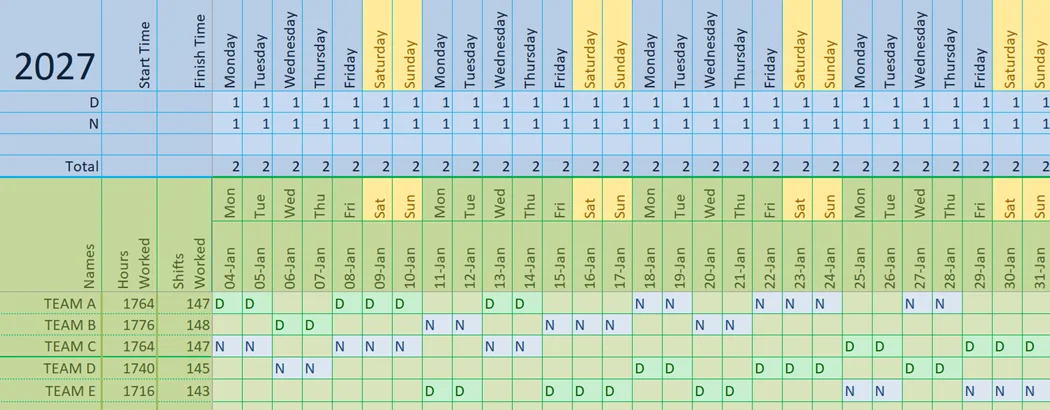
Example: 2‑3‑2 Shift Pattern Before Abstractions
Each team works a different number of shifts across the year, between 143 and 148, because the five‑week rotation doesn’t divide evenly into 365 days. This illustrates how end‑of‑year rollover creates natural variation before holidays, sickness, and training are applied.
2. Check the total shifts worked
Before absences and training, the pattern shows:
- Between 143 and 148 shifts per person per year
That variation is normal. After sickness, training, and shift swaps, the totals will change again.
So the first question is:
How many of those hours were part of the contract, and how many were overtime?
4. Understand fairness in rolling patterns
In a rolling pattern, nobody controls where the year starts or ends. Next year, the rotation will move — and someone else will start on the busy end.That’s why it’s unfair to treat the end‑of‑year position as a reason for overtime or penalty.
Instead, overtime should be based on contracted hours, not pattern position.
6. Why this matters
This approach ensures:
- Fairness: nobody is penalised for their position in the cycle
- Transparency: everyone can see how overtime is calculated
- Accuracy: based on real hours, not assumptions
- Consistency: the same rule applies every year
7. Key takeaway
In rolling shift patterns, overtime should be based on actual hours worked above contract, not on where the year ends in the cycle.
VisualrotaX gives you the data instantly, so you can make fair, evidence‑based decisions.
1. Understand the pattern
In this example, we’re using a 2‑3‑2 shift pattern, a repeating five‑week cycle that runs continuously through the year.
Because the year has 365 days, not a multiple of five weeks, the pattern doesn’t end evenly. At the end of the year:
- Some people will have worked three shifts in the final 15 days
- Others will have worked eight shifts
That’s not an error, it’s simply where they fall in the rotation.
3. Define the baseline
The average number of shifts in the pattern is 146.
That means:
- Team B (148 shifts) worked two more than average
- Team E (143 shifts) worked three fewer than average
But does that mean Team B gets two shifts of overtime and Team E must work three more before they qualify?
Not necessarily.
5. Use VisualrotaX to identify true overtime
VisualrotaX makes this simple.
✅ Step 1: Check contracted hours
VisualrotaX knows exactly how many hours each person is contracted to work.
✅ Step 2: Check actual hours worked
It automatically totals every shift, holiday, sickness day, and training session.
✅ Step 3: Compare
VisualrotaX instantly shows who has worked more than their contracted hours — regardless of where they fall in the pattern.
✅ Step 4: Apply your overtime rule
Once you know the excess hours, you can apply your organisation’s overtime rule:
- Pro‑rata uplift (e.g., 1.6× basic salary)
- Exact‑day identification (if recorded separately)
- Annualised hours ledger (VisualrotaX does this automatically)
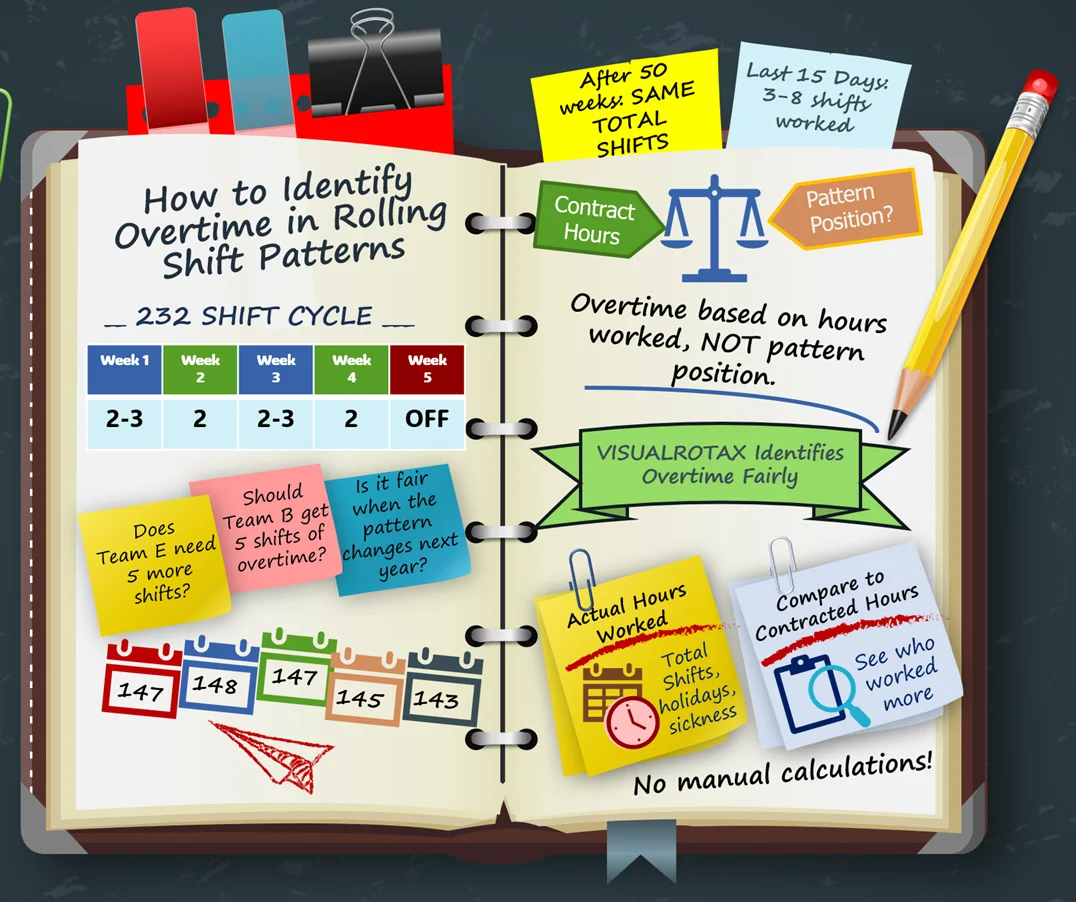
Notebook‑style guide: How to identify overtime in rolling shift patterns
This infographic explains why teams finish the year with different shift totals in a 2‑3‑2 pattern and shows how VisualrotaX identifies true overtime based on contracted hours rather than where the pattern happens to fall.
HowTo: Making End‑of‑Year Shift Patterns Fair
Every repeating shift pattern eventually collides with the calendar.
Whether it’s a 5‑week 2‑3‑2, a 4‑week rotation, or a 16‑week 4‑on‑4‑off, none of them fit neatly into 365 days.
That means every year, some people will finish the year having worked more shifts than others purely because of where the pattern falls.
Unions ask the same question every year:
“How do we make it fair?”
Here are the main options managers can use — each with its pros, cons, and fairness implications.
Option 2: Create a 365‑Day Shift Pattern
Design the rota to fit exactly into the calendar year.
For example, in a 2‑3‑2 pattern, the last 15 days can be adjusted so everyone works six shifts, balancing the totals.
You can even call it a “Special Christmas Rota”, ensuring staff work either Christmas or New Year, but not both.
✅ Pros
- Very fair
- Popular with staff
- Easy to communicate
- Solves the rollover problem completely
⚠️ Cons
- Slight variation in weekends or nights worked
- Requires small annual adjustment
💡 VisualrotaX Tip
VisualrotaX can model this automatically: showing how many shifts each person will work as you enter the shifts and helping you design the final two‑week balance.
Option 4: Under‑Roster and Use Banked Hours
Schedule slightly fewer hours than contract, and bank the difference.
Those hours can then be used for:
- covering absences
- training
- unexpected demand spikes
✅ Pros
- Flexible and fair
- Supports wellbeing
- Makes cover easier
⚠️ Cons
- Requires clear rules for using banked hours
- Needs good tracking
💡 VisualrotaX Tip
VisualrotaX manages Banked Hours automatically: tracking balances, usage, and fairness across the team.
Option 1: Annual Reconciliation (Ignore the rollover)
At the end of the year, simply reconcile the hours:
- If someone worked less than their contract → ignore it
- If someone worked more → pay overtime
✅ Pros
- Simple and quick
- Works well in stable patterns
- Easy to explain
⚠️ Cons
- Some staff may manipulate the system to stay under‑rostered
- Doesn’t prevent year‑end imbalance
- Requires careful monitoring
💡 VisualrotaX Tip
VisualrotaX automatically shows who has worked above or below their contracted hours, so reconciliation is instant and transparent.
Option 3: Over‑Roster Everyone
Schedule slightly more than contracted hours for everyone.
Then, any hours worked beyond contract are clearly overtime.
✅ Pros
- Transparent and fair
- Easy to calculate overtime
- No one is under‑rostered
⚠️ Cons
- Staff may feel overworked
- Requires careful fatigue management
💡 VisualrotaX Tip
VisualrotaX calculates total hours worked per person, so you can monitor fatigue and ensure fairness while keeping overtime clear.
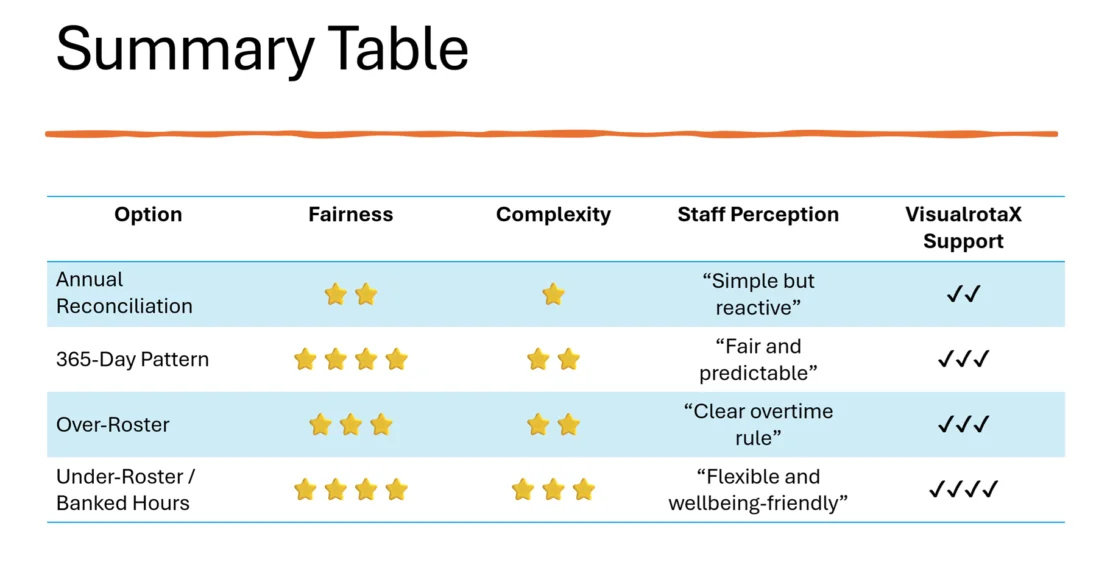
Key Takeaway
There’s no perfect calendar fit but fairness comes from transparency, consistency, and data.
VisualrotaX gives managers the visibility they need to make fair, evidence‑based decisions that unions and staff can trust.
📚 Further Reading: Understanding Overtime in Shift Work
If you’d like to explore related topics in more depth, these guides will help you build a fair, transparent, and well‑structured approach to managing hours in any shift‑based operation:
How to approve holidays fairly, avoid understaffing, and maintain operational stability.
Includes rules, fairness checks, and practical examples.
2. Banked Hours
A complete explanation of how to under‑roster safely, store hours, and use them to cover sickness, training, and peak periods.
Ideal for organisations wanting flexibility without losing fairness.
A practical guide to designing shift patterns that balance fatigue, fairness, and operational demand.
Essential reading for managers building or reviewing rotas.
4. Annualised Hours
How annualised hours work, how to calculate them, and how they support modern workforce planning.
Perfect for teams wanting predictable costs and flexible staffing.
How to move from one shift pattern to another without disruption, conflict, or unfairness.
Includes step‑by‑step guidance and communication templates.
A deeper look at fairness principles, including distribution of unpopular shifts, premium days, and end‑of‑year rollover issues.
Highly relevant to unions, HR teams, and operational leaders.
🚀 See How VisualrotaX Makes Overtime Easy
Understanding overtime is one thing: calculating it accurately is another.
VisualrotaX does the hard work for you:
- It records every shift, every holiday, every sickness day, and every swap
- It compares actual hours to contracted hours automatically
- It shows exact overtime hours for each person
- It supports pro‑rata, annualised hours, and exact‑day identification
- It makes fairness transparent, consistent, and easy to explain
If you want to see how VisualrotaX can simplify overtime calculations and make your shift operation fairer, clearer, and easier to manage: