The Five Shift Patterns Every Organisation Should Know (and When to Avoid Them)
April 24, 2026
A practical guide for leaders, planners, and operational managers
Shift patterns shape everything: service levels, fatigue, morale, retention, and the long‑term sustainability of your operation. Yet many organisations still rely on inherited patterns, outdated templates, or “what we’ve always done” — even when those patterns no longer match demand or workforce expectations.
If you already know which pattern you’re curious about, you can jump straight to it. Explore the rhythm of the 232 (Panama) Shift Pattern, dive into the flow of the DuPont Shift Pattern, or head directly to the familiar structure of the 4on‑4off Shift Pattern. You can also skip ahead to the balanced 554 Shift Pattern or the shorter‑shift feel of the 8‑Hour Shift Pattern. And if you’re comparing options, you can go straight to Choosing the Right Pattern for Your Organisation.

Image of people at a planning meeting where they have the calendar for the month and all the relevant dates for upcoming events in front of them.
This guide breaks down the five most widely used shift patterns, what they’re good for, where they fall short, and how to choose the right one for your operation. These shift patterns in their basic form are to cover flat staffing 24/7 operations.
The following five shift patterns are often used to provide the 24/7 background staffing for operations that are far from a flat 24/7 workload. For instance there are many operations which are not flat 24/7 but require a 24/7 presence with additional staff required over the day. Examples include 999 or 911, security and emergency repairs. The 24/7 background shift pattern is adapted and combined with a days only operation to match the workload.
A 12‑hour shift pattern does not mean the shifts themselves must be 12 hours long. The pattern simply describes the structure of the rota, not the exact paid or worked hours. Each organisation sets its own shift length to match workload, handovers, breaks and contractual rules.
For example, many companies run “12‑hour” patterns using 11 hours paid with a 1‑hour unpaid break, giving a 38.5‑hour week before holidays and absences. Others extend the shift to 12.5 hours to allow for handovers.
The same applies to “8‑hour” patterns — these are nominal labels. The actual paid and worked hours depend on your terms and conditions, break rules, handover requirements and contracted weekly hours. Our models use the real shift length you need, not the nominal pattern name, these are merely the generic patterns.
The 232 Pattern (Panama) (12-hour shifts)
(2-Days on, 2 off, 3-Nights on, 2 off, 2-Days on, 3 off, 2-Nights on, 2 off, 3-Days on, 2 off, 2-Nights on, 3 off— repeating)
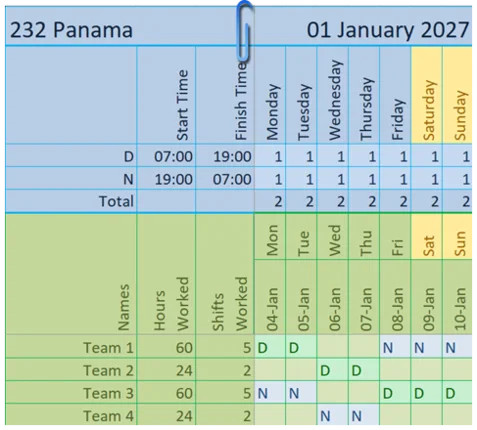
The 232 Pattern (Panama) using 12-hour shifts. It is displayed in VisualrotaX so you can see not only who is working each day but also how many shifts are on each day and the number of hours for each person.
Strengths
- Built‑in long weekends every cycle
- Good balance of work and rest
- Popular with workers who value predictable time off
- Provides strong coverage for 24/7 operations
- Continuity over the weekends
- Minimises working weekends
- Minimises fatigue
- Good for overtime
- Predictable, repeatable cycle
Weaknesses
- Only 2 days off after nights
- Uneven weekly hours unless averaged over a cycle
- Requires four teams to staff effectively
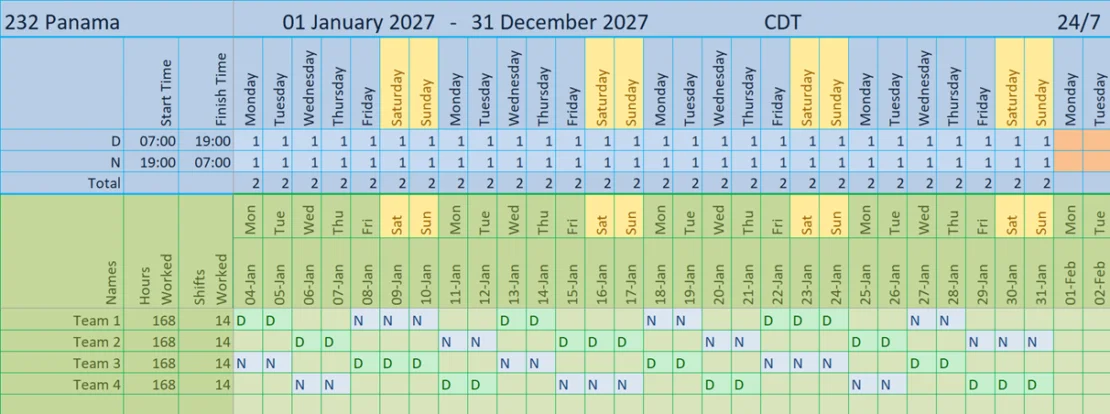
The 232 Pattern (Panama) using 12-hour shifts. It is displayed in VisualrotaX over four weeks. It is clear that everyone over the four week period is working the same number of shifts in the same order, just one week offset.
Ideal Use Cases
- Process industries
- Emergency services especially where fatigue can be disastrous
- Utilities
- Security
- Operations needing continuous staffing with predictable rest periods
- Moving from 8-hour operations to 12-hour operations
Wellbeing Implications
Workers need time to adapt to the cycle. They like the weekends but don't like the two days off after nights. It minimises fatigue and is extremely flexible. Ideal in a high overtime operation.
When to Avoid
If your operation relies heavily on part‑time staff or shift workers can't do nights, 232 can be difficult to maintain. It requires balanced teams. If your operation is not flat 24/7 you will need a variation. It also averages 42-hour week, if it's 12-hour paid. It can be adapted for other weekly hours but you will need a specialist to design it.
The DuPont Pattern (12-hour shifts)
(4-Nights on, 3-off, 3-Days on, 1-off, 3-Nights on, 3-off, 4-Days on, 7-off— repeating)
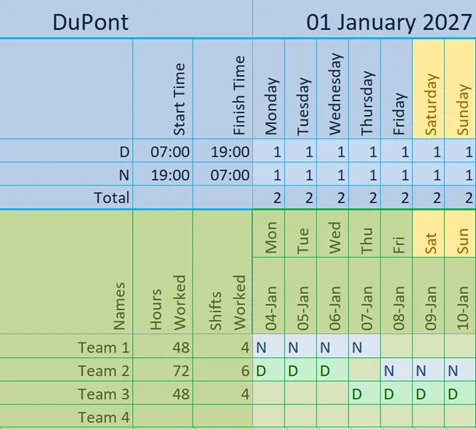
The Dupont shift pattern using 12-hour shifts. It is displayed in VisualrotaX so you can see not only who is working each day but also how many shifts are on each day and the number of hours for each person.
Strengths
- Long recovery periods — including a full 7‑day break
- Strong coverage for 24/7 operations
- Popular with workers who value extended time off
- Predictable, repeatable cycle
- Continuity over the weekends
- Minimises working weekends
Weaknesses
- The 4‑night run is extremely demanding and fatiguing
- High fatigue risk without robust controls
- Not suitable for all age groups or job types
- Requires four teams to staff effectively
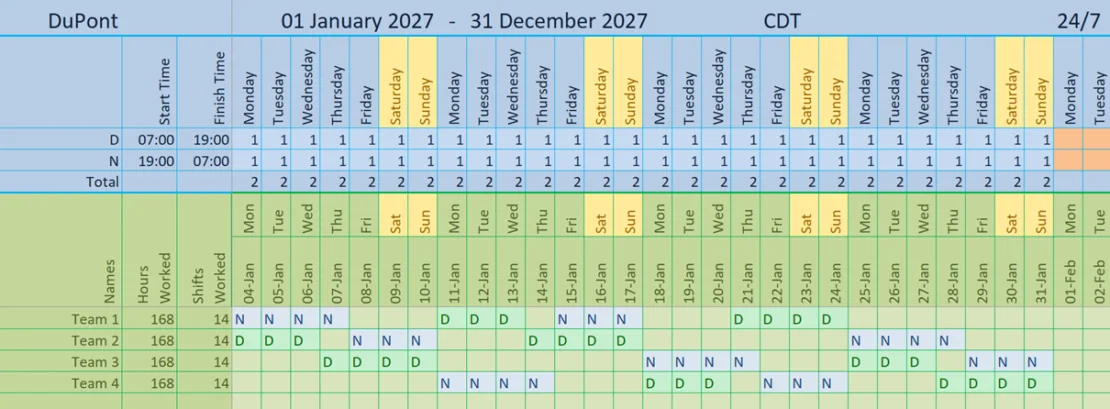
The DuPont Shift Pattern using 12-hour shifts. It is displayed in VisualrotaX over four weeks. It is clear that everyone over the four week period is working the same number of shifts in the same order, just one week offset.
Ideal Use Cases
- Industrial operations
- Energy and utilities
- Large‑scale manufacturing
- Environments where long breaks are valued
- Monotonous or repetitive work
When to Avoid
If your operation involves safety‑critical tasks or high cognitive load during nights, the 4‑night block may be unacceptable. Not recommended for any operations where errors can be dangerous to health. It requires balanced teams. If your operation is not flat 24/7 you will need a variation. It also averages 42-hour week, if it's 12-hour paid. It can be adapted for other weekly hours but you will need a specialist to design it.
Wellbeing Implications
The long rest periods are excellent for recovery, but the 4‑night stretch can be physiologically punishing. Fatigue management must be non‑negotiable.
The 4 On / 4 Off Pattern (12-hour shifts)
(Four 12‑hour shifts followed by four days off)
Note: Other shift pattern displayed here are for four people 24/7 operation and work on a four week pattern. The 4on-4off is also for four people or teams but the rotation is 16-weeks so is depicted differently.
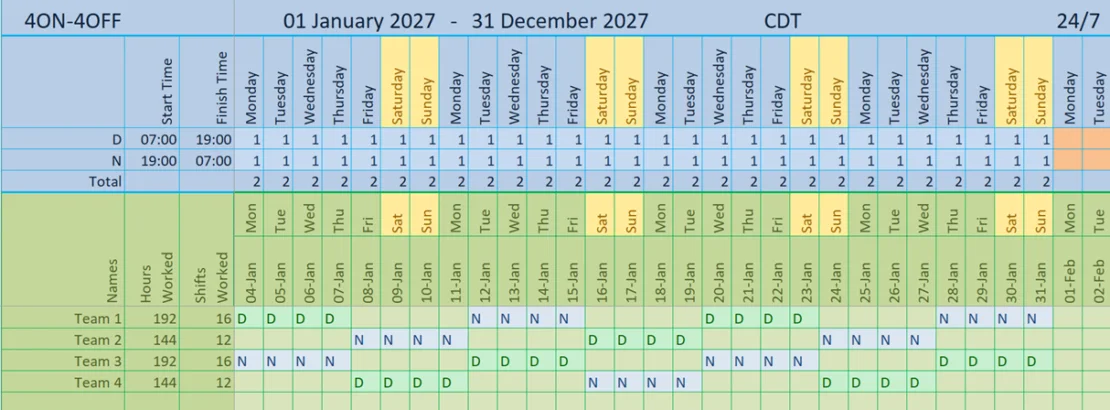
The 4on-4off shift pattern using 12-hour shifts. It is displayed in VisualrotaX so you can see not only who is working each day but also how many shifts are on each day and the number of hours for each person. The 4on-4off does not fit into a week, so over the four weeks displayed here, each person is not working the same number of shifts or working the same number of hours.
Weaknesses
- The 4‑night run is extremely demanding and fatiguing
- Limited flexibility for part‑time arrangements
- Can create long periods without seeing colleagues or managers
- Weekends are very popular for holidays and extremely hard to cover
- Long cycle at 16-weeks
- Only two or three whole weekends off out of eight
- Working on ~35 weekends per year before holidays
- Difficult to predict if you will be working on a set date without the full rota for reference
- Requires four teams to staff effectively
Strengths
- Simple, predictable, easy to understand
- Long breaks support recovery
- Works well for 24/7 coverage with minimal handovers
- Popular with many workers due to extended time off
- Well known
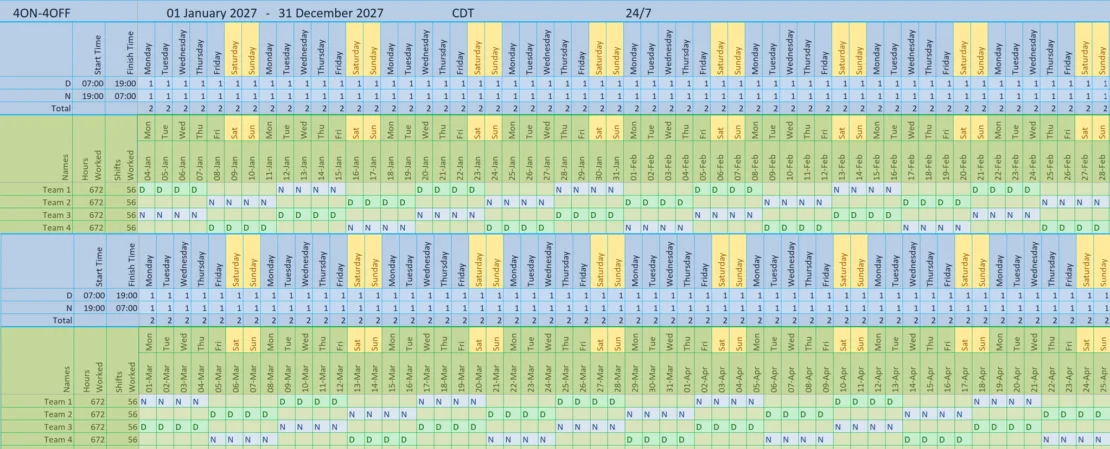
The 4on-4off Shift Pattern using 12-hour shifts. It is displayed in VisualrotaX over 16-weeks. It is clear that everyone over the 16-week period is working the same number of shifts in the same order, just four-days offset. The first 8-weeks is displayed over the second 8-weeks. You can see that if you started the 4on-4off pattern in January you wouldn't repeat it till Late April. You can also see how the weekends are affected on this pattern, where there are whole weekends and split weekends.
Ideal Use Cases
- Logistics
- Emergency services which is reactive and has high levels of downtime on shift
- Transport
- Security
- Operations where long shifts are acceptable and continuity matters
When to Avoid
Weekend coverage is poor, because of the propensity to book holidays at the weekend. Combined with a lack of enthusiasm for working overtime at weekends, the result is reduced staffing levels at weekends. Do not use if your operation involves safety‑critical tasks or high cognitive load during nights, the 4‑night block may be unacceptable. Not recommended for any operations where errors can be dangerous to health. Do not use if reduced staffing effects operations or is a safety concerns especially at weekends. It requires balanced teams. If your operation is not flat 24/7 you will need a variation. It also averages 42-hour week, if it's 12-hour paid. It can be adapted for other weekly hours but you will need a specialist to design it.
Wellbeing Implications
The long shifts can increase fatigue, especially during nights. This is arguably the most fatiguing shift pattern for 24/7. There is also a great deal of issues with weekend coverage. With split weekends workers are 50% more likely to book a single weekend shift to give them a full weekend off. However as the table above demonstrates they have to work five or six consecutive weekends before having a full weekend off. This makes them disinclined to work overtime to cover for holidays on their two or three weekends off. If they work an extra overtime shift they are now working five consecutive shifts.
The 554 Pattern (12-hour shifts)
(2-Days on, 2-Nights on, 5 off, 2-Days on 3-Nights on, 4 off, 3-Days on, 2-Nights on, 5 off, — repeating)
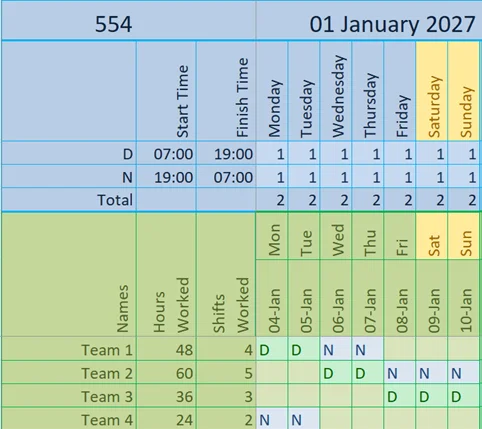
The 554 Shift Pattern using 12-hour shifts. It is displayed in VisualrotaX so you can see not only who is working each day but also how many shifts are on each day and the number of hours for each person.
Strengths
- Built‑in long weekends every cycle
- Good balance of work and rest
- 24-hour break in the middle of the block of shifts
- Popular with workers who value predictable time off
- Provides strong coverage for 24/7 operations
- Continuity over the weekends
- Minimises working weekends
- Minimises fatigue
- Long recovery periods — including 5‑day breaks
- Predictable, repeatable cycle
- Popular if the workers are used to 4on-4off
- Long break after nights
Weaknesses
- Overtime has to be fitted into their long breaks
- Slightly more fatiguing than the 232 but a lot better than the 4 consecutive nights patterns
- Uneven weekly hours unless averaged over a cycle
- Requires four teams to staff effectively
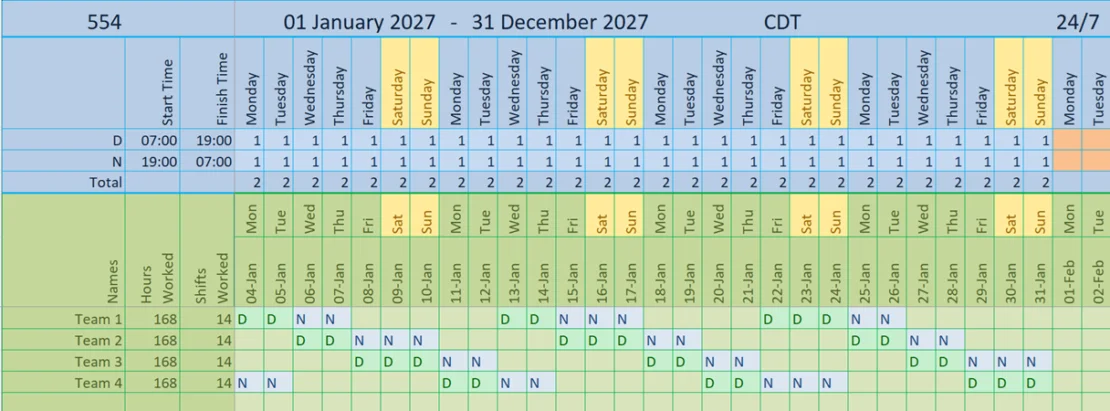
The 554 shift pattern using 12-hour shifts. It is displayed in VisualrotaX over four weeks. It is clear that everyone over the four week period is working the same number of shifts in the same order, just one week offset.
Ideal Use Cases
- Process industries
- Utilities
- Security
- Emergency services
- Operations needing continuous staffing with predictable rest periods
- Moving from 4on-4off operation because of the weekend and fatigue issue
Wellbeing Implications
Workers need time to adapt to the cycle. They like the weekends, they like the long breaks but five consecutive shifts can be daunting until they try it. The 24-hour break in the middle of the block of shifts minimises fatigue. Long breaks after nights helps to minimise disruption to their personal lives. Not ideal in a high overtime operation, but moderate overtime can be easily incorporated.
When to Avoid
If your operation relies heavily on part‑time staff or shift workers can't do nights, 554 can be difficult to maintain. It requires balanced teams. If your operation is not flat 24/7 you will need a variation. It also averages 42-hour week, if it's 12-hour paid. It can be adapted for other weekly hours but you will need a specialist to design it.
The 8-hour 232 Pattern
(Typically 8‑hour shifts rotating across mornings, afternoons, and nights)
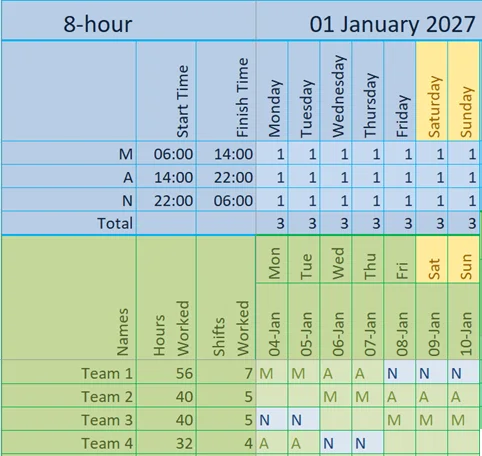
The 232 Shift Pattern using 8-hour shifts. It is displayed in VisualrotaX so you can see not only who is working each day but also how many shifts are on each day and the number of hours for each person. These shifts are M for morning shifts 6am-2pm, A for Afternoon shifts 2pm-10pm and N for night shifts 10pm to 6am.
Strengths
- Shorter shifts so workers feel able to do activities before and after shifts
- Good for operations needing three distinct daily coverage periods
- Shifts can be extended to 12-hours to cover for absences
- More compatible with part‑time or flexible arrangements
- Working whole weekends and have a full three day weekend off every four weeks
- Management can see all of the teams each week
Weaknesses
- Many assume that shorter shifts reduce fatigue, this is erroneous
- Only 2-off between blocks of shifts can disrupt sleep
- More handovers increase risk of communication gaps
- Can feel less predictable than fixed‑shift systems
- Frequently poor understanding of shift working results in overtime being used as double shifts to cover for absent colleagues, this is highly fatiguing and wasteful
- Requires four teams to staff effectively
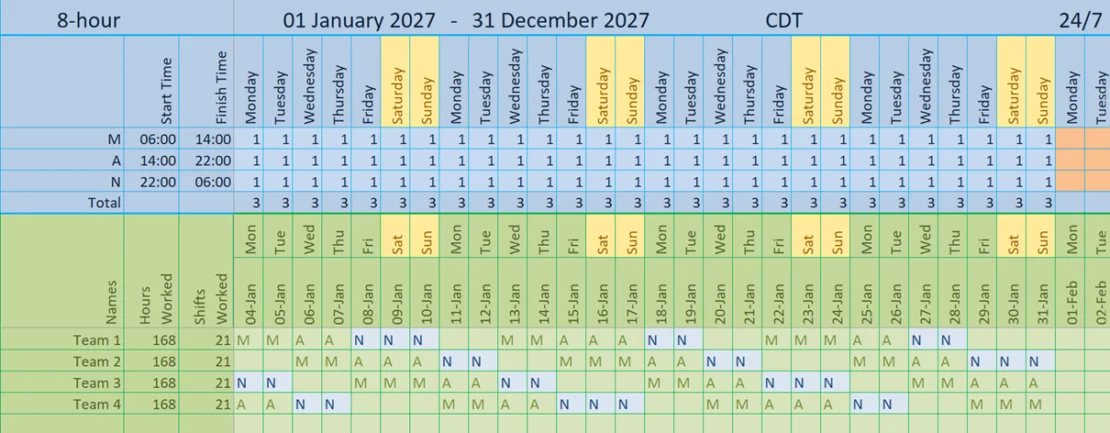
The 232 Pattern using 8-hour shifts. It is displayed in VisualrotaX over four weeks. It is clear that everyone over the four week period is working the same number of shifts in the same order, just one week offset. There are three people in each day and they work three out of four weekends.
Ideal Use Cases
- Manufacturing
- Customer service centres
- Transport hubs
- Any operation needing three daily shifts with consistent staffing
- Physically intensive jobs
Wellbeing Implications
Many believe that shorter shifts are less fatiguing, this is not true because of the start times. It can however be adapted if this is a consideration. Physically demanding jobs are better with shorter shifts. The two days off between blocks of shifts can be an issue because of the disrupted circadian rhythms, if not managed carefully. Staff feel able to do activities before and after their shift, so they often like 8-hour shifts to fit in with their home-life. If double shifts are used to cover for absences, this is very fatiguing and counter productive. The 8-hour operation can be quickly adapted to 12-hour shifts for covering absences. However if this is a frequent occurrence, 12-hour shifts are often better as they minimise disruption.
When to Avoid
The additional handovers can be expensive or disruptive to the operation. It requires balanced teams. If your operation is not flat 24/7 you will need a variation. It also averages 42-hour week, if it's 8-hour paid. It can be adapted for other weekly hours but you will need a specialist to design it. If your workers are used to 12-hour shifts, they will hate this pattern and most likely leave for a job using 12-hour shifts.
Choosing the Right Pattern: The Leadership Lens
No shift pattern is universally “good” or “bad”. Each one is a tool and the right tool depends on your demand profile, workforce demographics, operational risks, and organisational culture.
The best shift pattern is the one that:
- matches demand
- protects wellbeing
- supports fairness
- minimises fatigue
- is operationally sustainable
- is understood and trusted by the workforce
A pattern that looks efficient on paper but fails to support people will never deliver long‑term performance.
Shift patterns are strategic assets. When designed well, they reduce costs, improve service, strengthen wellbeing, and build trust. When designed poorly, they create fatigue, turnover, conflict, and operational fragility.
Understanding these five core patterns — and when to avoid them — gives leaders the foundation to build shift systems that work today and remain resilient tomorrow.
At C‑Desk Technology and VisualrotaX, we design shift patterns that work: for the organisation, for the operation, and for the people who deliver it. Our approach is human‑led and operationally grounded. We create patterns that minimise cost, maximise efficiency, and genuinely support the wellbeing of the workforce. Because when a shift pattern is built properly, with fairness, logic, and operational sense, it works first time. And it keeps working.
If you want a rota that people trust, a system that managers can stand behind, and an operation that performs at its best, we’re here to help you build it.
Our Business Health Check is perfect for operations and managers wondering if their shift pattern is fit for purpose or if there is a better one out there. To find out more about shift operations please follow this link.
Recommended Reading
If you’re exploring shift patterns, rota design or improving your workforce operations, these pages, courses and books offer practical guidance and deeper insight.
📘 How to Manage Your Shift Pattern (Course & Book)
Our most comprehensive training for managers who want to run a smooth, efficient and people‑focused shift operation.
- Online course: 16 hours of step‑by‑step video tutorials, examples and tools covering holidays, absences, fatigue, staffing levels and day‑to‑day management.
- Book: How to Manage Your Shift Pattern — a practical reference guide packed with worked examples, summary pages and real shift pattern solutions. Ideal for anyone responsible for designing, running or improving a shift pattern.
📊 Business Health Check
A fast, expert assessment of your current shift operation. You receive:
- a detailed diagnostic report
- clear, actionable recommendations
- a fully developed annual shift pattern Perfect if you want independent advice, alternative shift pattern options or support with long‑term planning.
🎓 Shift‑Scheduling Course (Thinkific)
A 3.5‑hour introductory course designed for managers who need a new shift pattern but aren’t sure where to begin. Includes:
- videos on designing a shift pattern
- guidance on calculating staffing levels
- software tools to help you build and manage your rota A practical starting point for anyone new to shift design.
🏭 C‑Desk Technology Expertise
Since 1996 we’ve designed tailored workforce operations for organisations across manufacturing, healthcare, logistics, hospitality, emergency services and global corporate environments. This page showcases real project examples and demonstrates how we create shift systems that balance efficiency, fairness and operational resilience.
🕒 Banked Hours
To learn how Banked Hours work inside the 232 pattern, read our HowTo Banked Hours guide. Banked Hours is one of the simplest and most effective ways to give your operation flexibility while giving staff more predictable time off. It replaces overtime, firefighting and last‑minute rota changes with a calm, fair, transparent system that works across the whole year, not just week to week.
If you want to learn how to design a shift pattern from scratch — one that matches your workload and staffing levels — explore our step‑by‑step Shift Pattern Design Guide.