Why Every Organisation Needs a Holiday Management Plan (And Why It Pays for Itself)
Managing holidays in a 24/7 shift operation is one of the biggest hidden causes of staffing shortages, fatigue and unexpected overtime. Without a clear holiday management plan, even well‑designed shift patterns become unstable, especially during the summer peak. In this guide, we show how unmanaged holiday booking creates unpredictable staffing levels, why averages hide the real risk, and how a simple, fair holiday management plan can stabilise your operation and dramatically reduce overtime.
Impact on Managers of Not Having a Holiday Management Plan
Most managers spend far too much time dealing with holiday requests. Not because employees are unreasonable, but because the organisation has no clear, agreed‑upon system for how holidays should work. Every request becomes a negotiation. Every exception becomes a precedent. Every decision becomes a potential conflict.
But here’s the truth: A well‑designed Holiday Management Plan is one of the highest‑value investments you can make in your operation. It saves time, reduces conflict, improves fairness, and gives employees clarity long before they submit a request.
Holiday management doesn’t have to be reactive. It can be structured, predictable, and remarkably efficient.

Holidays are about relaxation away from work, so that when you come back you are ready to work. A Holiday Management Plan allows all your employees and managers to enjoy a relaxing break.
Planning Holidays in Advance Saves Managers Hours of Time
When you don’t have a plan, every holiday request becomes a puzzle you must solve on the spot:
- Can we cover this?
- Who else is off?
- What’s the minimum staffing?
- What’s the rule for peak periods?
- What did we do last time?
Most managers think holiday management is simple: an employee submits a request, you log it, you approve it, and that’s the end of it. But anyone who has ever run an operation knows that’s the easy part and it’s the smallest part.
The real time drain isn’t approving holidays.
It’s thinking about holidays.
Every request triggers a chain reaction:
- Can you find cover?
- If not, can the work be rescheduled?
- Will deadlines need to move?
- Do you need overtime — and all the paperwork that comes with it?
- Does the person off hold a key skill you can’t replace?
- What does that mean for the rest of the team?
- What does that mean for tomorrow? Or next week?
And because most managers are already stretched, these decisions get pushed to the day the holiday actually occurs. People hope it will sort itself out. It rarely does.
So the manager ends up firefighting, every single day.
Looking at the workload.
Looking at the skills available.
Trying to piece together a plan that keeps the operation afloat.
Even a well‑organised manager will spend around an hour per holiday shift once you factor in the thinking, checking, rearranging, and covering. Put that into perspective: a manager with just ten employees can easily lose a full day every week to holiday management alone. For most managers, it’s double that.
Holiday management isn’t a quick admin task.
It’s operational risk management: done daily, under pressure, and often without the tools or policies to make it easier.
A Holiday Management Plan eliminates this entirely.
When the rules are already written:
- you don’t negotiate
- you don’t improvise
- you don’t reinvent the wheel
- you simply follow the process
The decision is already made: you’re just applying the system.
A good plan pays for itself in the first month.
Transparency Turns Holiday Requests Into Solutions, Not Problems
When employees don’t know the rules, they come to you with uncertainty:
“Can I take this day off?” “Is this allowed?” “Will this cause a problem?”
Then they don't come with a holiday request, they come with their entire life stories as to why they need this particular day off:
“It's my child's birthday” “My 85 year old Nana is coming back over to England after 30 years. This is the only week she is over here and I can see her.” “My wife booked tickets to the theatre as a surprise for our anniversary and forgot that I'm on Lates that day.”
Then if you fail to grant the request, it's not them you are letting down: it's their family, their friends. That is what makes denying a request so hard.
But when the rules are clear, published, and understood by everyone, something powerful happens:
Employees start checking the rules first. They come to you with solutions, not problems.
They already know:
- how many people can be off
- which days are restricted
- how far in advance they must request
- what the approval criteria are
This reduces friction, reduces disappointment, and reduces the emotional labour managers carry.
Transparency is not just good practice: it’s operational efficiency.
Real Data: What Happens When You Don’t Have a Holiday Management Plan
This example comes from a real 24/7 operation working 12‑hour shifts. 12-hour Day and Night shifts
They had 20 people on shift, so 40 each day, with five of those per shiftintended to cover holidays and absences. On paper, it looked simple: “On average, three people are off each shift. We can cope with that.” Yet their overtime bill was enormous, and no one understood why.
When we analysed their holiday data, the truth became clear.
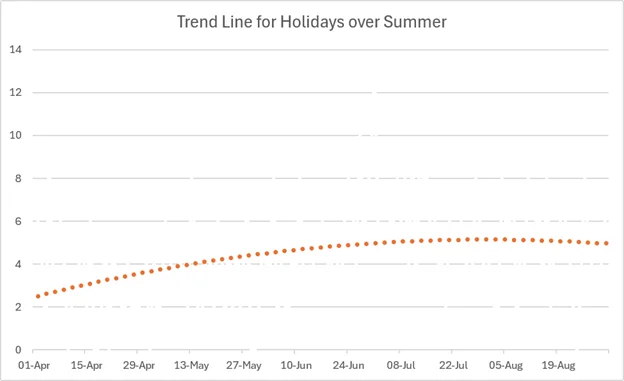
Average number of people off each shift over the summer. The trend looks stable, rising from around 2 to 5.5 people off — but this average hides the real day‑to‑day variation.
The Trend Looked Fine But It Hid the Real Problem
The first graph shows the average number of people off each shift across the summer. It starts at around 2 people off and peaks at around 5.5 people off.
At first glance, this looks manageable. If you expect around five people off, and you have five people available for cover, you’d assume only a small amount of overtime would be needed.
But averages hide the real story.
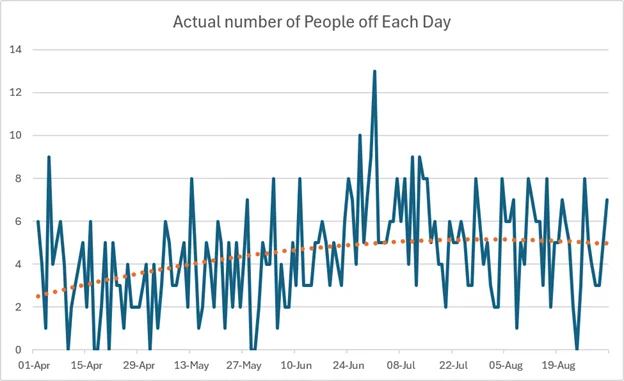
Real daily holiday numbers showing extreme variation from 0 people off to 13 people off on the Day shift Thus explaining why overtime spiked despite a seemingly manageable average.
The Day‑to‑Day Reality Was Chaos
When we looked at the daily numbers for the Day Shifts, the picture changed completely. Instead of a steady five people off, the real data showed:
- some days with 0 people off
- some days with 13 people off
- and every number in between
This is why their overtime bill exploded. They weren’t dealing with a steady, predictable level of absence. They were dealing with wild swings, and every spike meant last‑minute overtime.
The average of 5.5 hid the fact that the system was completely unstable.
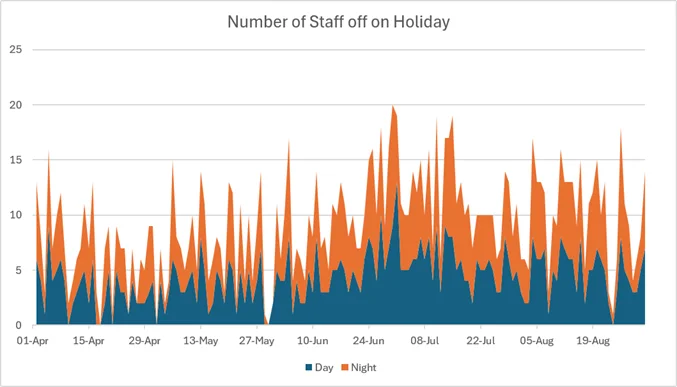
Combined daily totals for both Day and Night shifts (stacked graph), revealing a saw‑tooth pattern of unpredictable staffing levels and frequent drops below the minimum safe staffing threshold. With up to 20 people missing each day, overtime was becoming unmanageable.
Both Shifts Were Affected Like a Saw Blade
When we combined both shifts, the pattern looked like a saw blade with sharp peaks and troughs, day after day. The operation needed at least 15 people on shift to run safely. Whenever numbers dropped below that, they called people in on overtime.
They believed these were “one‑offs”. But the data showed that over the summer they averaged 1.5 people on overtime every single day. The rest of the year was fine. The problem was the summer free‑for‑all with everyone taking holidays whenever they wanted, with no plan to spread demand.
The Solution: A Holiday Management Plan
We introduced a simple, fair holiday management plan that allowed people to take time off in turn. Nothing else changed:
- the same number of staff
- the same level of cover
- the same holiday entitlement
But the results were dramatic:
- overtime dropped sharply
- staffing became predictable
- managers could plan ahead
- employees were happier because they weren’t being called in last‑minute
- summer became manageable instead of chaotic
Most importantly, people didn’t want overtime in the summer as it disrupted their own time off. The plan protected both the operation and the employees.
A Plan Designed Before Requests Come In Removes Bias Completely
Fairness is not a feeling. Fairness is a system.
If you write your holiday rules after requests come in, you will always be accused of bias: even if you’re trying to be fair. But if you write your rules before any requests are submitted:
- you cannot favour anyone
- you cannot discriminate
- you cannot be influenced
- you cannot be inconsistent
The rules apply equally to everyone because they were created for the operation, not for individuals.
This is what makes the system fair. A good Holiday Management Plan protects managers from accusations of favouritism and protects employees from inconsistent treatment.
Employees Trust a System That Treats Everyone the Same
When holiday decisions feel personal, people take them personally. A holiday is not a holiday. A holiday is: your child's birthday, your summer break with the family, your anniversary, a Christmas party. A holiday is your personal life. Its personal, and if a manager denies a request if feels personal. So any sign of favouritism is seen as a betrayal.
But when decisions are based on:
- clear rules
- transparent criteria
- operational logic
- consistent application
…trust grows.
Employees may not always get the exact days they want, but they will understand why. And understanding is what prevents resentment. A fair system is one that minimises unfairness and a Holiday Management Plan does exactly that.
Creating the Rules Takes Time and Expertise — But You Don’t Have to Start From Scratch
Designing a robust Holiday Management Plan is not a five‑minute task. You must consider:
- minimum staffing
- skill mix
- peak periods
- fairness rules
- carry‑over
- part‑time arrangements
- bank holidays
- seasonal demand
- emergency exceptions
- communication protocols
It takes experience to get this right — and even more experience to anticipate the variations, edge cases, and “what ifs” that cause problems later.
That’s exactly why I wrote 📘 Holidays and Absence Management.
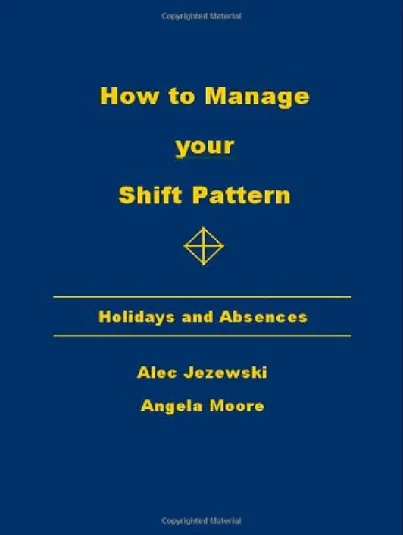
A practical book on shift pattern design, holiday management and rota planning. That shows managers how to run and maintain a fair, efficient shift pattern including: holidays, absences, staffing levels and day‑to‑day management.
How to Manage your Shift Pattern book contains:
- a complete Holiday Management Plan
- ready‑made rules
- worked examples
- templates
- variations for different operations
- guidance on fairness, transparency, and communication
You can use it as‑is or adapt it to your organisation. Either way, it gives you a proven, structured system that removes the guesswork and gives managers confidence. A Holiday Management Plan is not paperwork. It is not bureaucracy. It is not “extra work.” It is one of the most effective tools you can give your managers and one of the clearest signals of fairness you can give your employees.
Plan once. Save time all year, every year. Build trust every day.
If you want a ready‑made, field‑tested plan you can implement immediately, How to Manage your Shift Pattern gives you everything you need to create a fair, transparent, efficient holiday system that works for everyone.
What to Do Next
If you are having trouble with holidays and would like an effective Holiday Management Plan, there are several ways to strengthen your own holiday and absence management:
Explore the Five Most Common Shift Patterns
Understand the strengths, weaknesses and wellbeing implications of the patterns used across 24/7 operations. See examples of popular shift patterns.
Learn How to Manage Holidays and Absences Effectively
Our How to Manage Your Shift Pattern course and book give you step‑by‑step guidance, examples and tools to build a fair, predictable system. Read more about our training on the How to Manage Your Shift Pattern page.
Assess Your Current Operation
If you’re unsure where the problems are coming from, our Business Health Check provides a clear, expert assessment and a fully developed annual shift pattern. Learn more on our Business Health Check page.
See How Other Organisations Improved Their Operations
Browse real project examples from manufacturing, healthcare, logistics, emergency services and more. See examples of our work on the C‑Desk Technology Expertise page.
How One Wedding Planning Team Fixed Their Holiday Problem Overnight
Discover how one organisation solved their holiday issues which were undermining the business. A holidays‑included shift pattern transformed their operation and protected key wedding dates months in advance. Read the full story on our Wedding Planning Holidays‑Included Shift Pattern page.
Discover the Two Main Approaches to Holiday Management
If you want to understand the different ways to manage holidays in shift work, explore our guide to Holidays Included shift patterns and Holiday Management Plans.