BANKED HOURS
A fair, flexible system that works for your people and your operation
Banked Hours is a modern, flexible way of working that gives organisations the cover they need and gives employees the time off they want. Instead of relying on overtime, agency staff, or last‑minute firefighting, Banked Hours creates a small reserve of paid hours that staff work only when needed and take back as time off later.
It’s fair, predictable, and cost‑effective. And when it’s implemented properly, it transforms the relationship between staff and management.
What Banked Hours Are: In Plain English
Banked Hours means employees are paid in advance for a small number of hours they may work if required. Typically:
- 90% of hours are scheduled
- 10% are banked
When demand increases, staff work from their bank.
It’s a fair exchange: flexibility for the business, quality time off for the employee.
Why Organisations Use Banked Hours
Banked Hours solves problems that traditional systems simply can’t:
- Reduces overtime and agency spend
- Provides predictable cover for busy periods
- Reduces stress on managers
- Improves fairness and transparency
- Supports wellbeing and work/life balance
- Helps avoid last‑minute rota changes
- Creates a calmer, more resilient operation
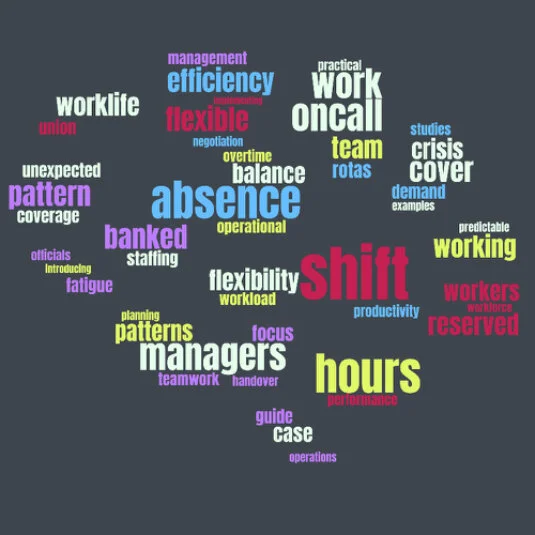
Word Cloud on Banked Hours and what it means to shift workers.
A Better Way to Run Shift Work
In just two minutes, discover how Banked Hours balance operational needs with fairness, wellbeing and real flexibility.
How Banked Hours Work in Practice
Here’s the structure most organisations use:
Step 1 — Set the Bank
Usually 10% of contracted hours.
Step 2 — Use the Bank When Needed
Busy week? Demand spike? Sickness? Staff work from their bank.
Step 3 — Give Time Back
Quiet week? Low demand? Staff take paid time off.
Step 4 — Track It Properly
VisualrotaX handles this automatically: hours in, hours out, fairness, transparency.
Why Staff Like Banked Hours
Banked Hours is not about squeezing more work out of people. It’s about giving them:
- More predictable time off
- Longer breaks across the year
- Fairer distribution of extra hours
- Paid time off when demand is low
- Clear rules and expectations
- A system that works with them, not against them
When done properly, Banked Hours is one of the most staff‑friendly systems available.
Example: How Banked Hours Work Across a Real Year
Banked Hours isn’t about day‑to‑day tinkering. It’s about giving an operation the flexibility it needs across the whole year. Especially during the weeks when demand spikes and the normal staffing level simply isn’t enough.
Here’s a real‑world example from a repair and maintenance team working 10‑hour shifts, averaging four shifts per week, on a holidays‑included pattern.
They have:
- 10 people in the team
- Staggered start times to match workload
- 10% of their hours banked
- 10 weeks off per year because Banked Hours replace the weeks they would otherwise be working
- Cover responsibilities on their days off outside their long breaks
In a normal week, they work around 40 hours.
In a busy week, they may work closer to 50 hours, but they get longer breaks and more quality time off across the year.
A Busy Week: Why Extra Cover Is Needed
Some weeks simply need more people. For example:
- A major shutdown requiring deeper cleaning
- Severe weather causing a surge in repair jobs
- A large event (World Cup, festival, race weekend) increasing demand
- A regulatory inspection requiring extra preparation
- A customer contract deadline creating a short‑term spike
- A seasonal peak such as harvest, tourism, Christmas or summer
Normally, the team needs five people on days.
But this week, they need six.
How Banked Hours Handle the Spike
1. Increase staffing from five to six
The first layer of flexibility:
Bring in one extra person using Banked Hours.
No overtime. No agency. No stress.
2. Add extended shifts for two team members
Two members are placed on extended shifts, allowing them to work up to 12 hours if needed.
This gives the operation:
- A bigger team
- A longer working window
- A buffer for unexpected jobs
- A way to absorb peaks without chaos
3. Maintain fairness and wellbeing
Because the team has 10% of their hours banked, they can:
- work more during busy weeks
- take more time off during quiet weeks
- enjoy 10 weeks of holidays‑included rest
- gain additional paid weeks off if not all Banked Hours are used
Busy weeks are balanced by longer breaks, not burnout.
The Multi‑Layered Approach in Action
This example shows how Banked Hours create a flexible, resilient operation:
- Layer 1 — The Shift Pattern A 10‑person team with staggered start times and holidays included.
- Layer 2 — The Banked Hours Reserve 10% of hours held in reserve.
- Layer 3 — Increased Staffing Raising the team from five to six during busy weeks.
- Layer 4 — Extended Shifts Two team members able to work 12‑hour shifts.
- Layer 5 — Recovery Time Long breaks and additional paid weeks off when the bank isn’t fully used.
This is why Banked Hours work so well: flexibility when you need it, rest when you don’t.
For a full walkthrough on designing and implementing Banked Hours, visit our HowTo Banked Hours page.
Banked Hours vs Overtime vs TOIL
A simple comparison:
Feature | Banked Hours | Overtime | TOIL |
Predictable |  |  | |
Fair | | Not often | Sometimes |
Cost-effective | | Sometimes | |
Supports wellbeing | | | |
Increases time off | | | |
Increases pay | | | |
Works for shift work | | Sometimes | Sometimes |
A simple comparison of Banked Hours vs Overtime vs TOIL
Policies That Support Banked Hours
Banked Hours only work when supported by clear procedures. These include:
- Holiday management
- Sickness and short‑notice absence
- Demand escalation rules
- Communication pathways
- Governance and fairness
See the Operational Policy Framework
Recommended Reading
If you’d like to explore the wider system that supports Banked Hours and makes shift operations run smoothly, these pages will help you build a complete understanding of how everything fits together.
Holiday Management
A clear explanation of the two approaches to managing annual leave — Holidays Included and Holidays Excluded with a Holiday Management Plan. This page shows how holiday rules, procedures, and fairness principles interact with your shift pattern and why a structured holiday process is essential for predictable staffing.
Operational Policy Framework
This page explains the policies that make your shift pattern work in real life. From holiday requests to sickness reporting, demand changes, communication pathways and governance, it shows how clear procedures create consistency, fairness and calm operations.
What Counts as Overtime in Shift Work?
To understand how overtime interacts with Banked Hours, read What Counts as Overtime in Shift Work. With detailed guide on HowTo: Identify Overtime in Rolling Shift Patterns and HowTo: Making End‑of‑Year Shift Patterns Fair it's essential reading for shift managers and HR
Shift Pattern Design Cycle
A step‑by‑step guide to designing a shift pattern that balances operational demand with employee wellbeing. This is the companion framework to Banked Hours — one focuses on design, the other on day‑to‑day operation.
Managing Sickness & Short‑Notice Absence
An overview of how to handle sickness and last‑minute absence in a way that protects fairness, reduces stress, and avoids firefighting. This page links closely with Banked Hours, because clear absence procedures prevent misuse and support transparency.
Business Health Check
A full diagnostic of your operation, covering shift patterns, policies, demand, staffing levels, and real‑world performance. This is ideal if you want to understand where your operation is strong, where it’s vulnerable, and how Banked Hours can be integrated effectively.
Take Ban
ked Hours Further: Book + Video Course
If you want to go deeper, I’ve created two resources that walk you through Banked Hours step‑by‑step:
Flexible Shift Working: A New Approach Using Banked Hours
My book explains the full methodology, the maths, the psychology, and the real‑world implementation. It’s practical, evidence‑based, and written for managers, HR, and operational leaders.
Banked Hours Video Training Course
A 3.5‑hour online course that covers:
- How Banked Hours work
- How to set the bank
- How to manage busy weeks
- How to communicate the system
- How to ensure fairness
- Real examples and case studies
Perfect for managers, supervisors, and anyone responsible for shift operations.
See how to calculate Banked Hours, plan long breaks, use cover shifts and manage B‑shifts in practice explore the HowTo FAQ Banked Hours guide.
Banked Hours
Banked Hours are a very efficient and effective way to run a shift operation.
Our book, available to download, or as an ebook on Kindle, or as a video series, explain how to set them up and how to use them to run the shift operation.
The topics covered in these include:
- Introduction to Banked Hours
- Creating Banked Hours
- Training and Flexible Working
- What Happens in Practice
- Benefits of Banked Hours and Flexible Working
- Extending Shift Lengths
- Sending People Home
- Abuses and Fears
- Union Negotiation
- Summary of Banked Hours and Flexible Working

Flexible Shift Working – Create Fair, Efficient and Truly Flexible Workplaces
Flexible working isn’t just a trend: it’s what employees want and what organisations increasingly need. But achieving real flexibility in a shift‑working environment can feel impossible. How do you give people the work/life balance they deserve while still ensuring the right skills are available at the right time? Flexible Shift Working shows you exactly how to strike that balance.
This book takes you step‑by‑step from the core concepts of Banked Hours and other flexible working techniques through to full implementation. You’ll learn how to design systems that are fair, transparent, and efficient, and how to avoid the common mistakes that cause flexible working schemes to fail.
Drawing on years of experience with organisations across production, security, utilities, call centres, and 24/7 operations, this book explains how Banked Hours can transform the way you manage staffing, absence, and workload. You’ll discover how a small amount of flexibility can prevent minor issues from becoming major operational problems, and how to “sell” the concept to both employees and managers so everyone feels confident and supported.
And it’s not just for shift workers. There’s even a dedicated section for traditional 9–5 operations, showing how flexible working principles can improve wellbeing, efficiency, and fairness in any workplace.
Whether you’re a manager, union official, HR professional, or simply someone who wants to understand flexible working properly, Flexible Shift Working gives you the practical tools, examples, and insights to make flexibility work for your people and your organisation.
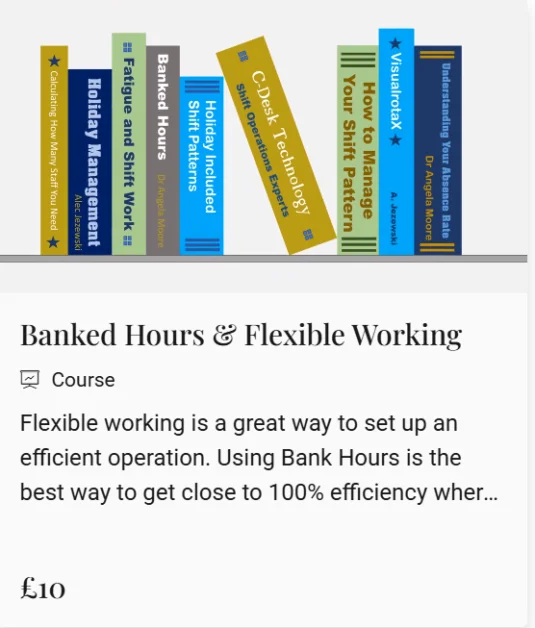
Banked Hours Kindle Book
Available on Kindle. Pages:133
Banked Hours is a great way to improve your shift pattern and ensure that shift workers have a better work/life balance.
For Managers of Operations that involve shift working, there are a number of essential tools that they need to know about and use if possible. Banked, or Reserved, Hours is one of them. This book looks at the details of introducing and using Banked Hours based on our experiences with the many organisations that use them.
There are many occasions when minor problems like unexpected absence can become a major crisis. However just a little bit of flexibility could solve the issue in an instant. The main problem with absence if it is not covered is that you rarely just lose the man hours associated with the absence. This is because your staff will work as a team and the loss of one person means that everyone else tries to do their job plus that bit extra. This leads to a reduction in efficiency, focus and ultimately productivity. This can then have a knock on effect to the next shift because work, that should have been done, is unfinished.
Bank Hours or Reserved Hours are the terms used to reference a particular technique of flexible working. Flexible working arrangements make the operation more efficient and cost effective. A flexible working arrangement means that you don’t have to schedule additional workers on to every shift to cover for absences.
This new edition covers how to negotiate Banked Hours, on-call rotas, benefits and the practical side of Banked Hours. There are also many examples of how Banked Hours can operate.
If you are a manager, union official or shift worker and want to know more about Banked Hours, this book is for you.
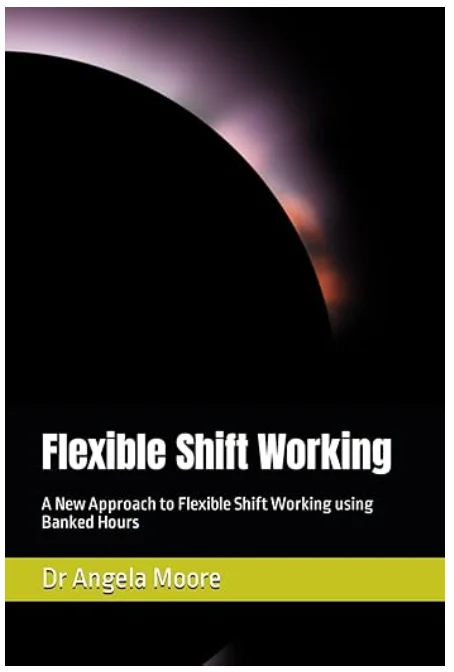
Banked Hours – Online Course (3.5 Hours of Video Training)
If you want to understand how Banked Hours really work in a shift‑working environment, this course gives you everything you need. Across 3.5 hours of clear, practical video content, you’ll learn exactly how to introduce, manage, and get the best from Banked Hours in your operation.
This course is designed for anyone who wants to use Banked Hours effectively, but it’s especially valuable for managers, supervisors, union officials, and shift workers who deal with the day‑to‑day realities of staffing, absence, and workload.
You’ll learn how to set up Banked Hours from scratch, how to build fair and transparent policies, and how to run the system smoothly once it’s in place. The course includes real examples of how organisations incorporate Banked Hours into their shift patterns, how they use them to cover unexpected absence, and how a small amount of flexibility can prevent a minor issue from becoming a major operational problem.
By the end, you’ll understand not just the theory, but the practical, lived‑in reality of using Banked Hours to improve work/life balance, protect productivity, and strengthen your shift pattern.

- Calculating Banked Hours
- What Happens in Practise when using Banked Hours
- Ad-hoc Workloads with Banked Hours
- Fairness and Banked Hours
- Uses for Banked Hours
- Flexible Shifts
- Training with Banked Hours
- Stepping up with Banked Hours
- Skills Matrix and Banked Hours
- Absence Cover using Banked Hours
- Cover Shifts and Banked Hours
- Work-life Balance and Banked Hours
- Benefits of Banked Hours
- Terms of Employment and Banked Hours
- Volunteering and Banked Hours
- Extending Shifts using Banked Hours
- Different Length Shifts and Banked Hours
- Multiple Approaches to Covering for Absences
- Sending Employees Home with Banked Hours
- Job and Knock with Banked Hours
- Rules for Fairness when Working Extra Hours
- Long Term Sick and Banked Hours
- The Danger of Forming a Ring
- Abuses of Banked Hours
- 4on-4off Example with Banked Hours
- Equalising Hours with Banked Hours
- Exampled of Shift Swaps with Banked Hours
- 2nd Example of Shift Swapping with Banked Hours
- Example of Carry Over of Banked Hours
- Example of 232 with Banked Hours
- Exampled of Banked Hours with 8-hour shifts
If you want a fair, flexible system that works for both your people and your operation, Banked Hours is one of the most effective tools you can use.
Get in touch and let’s design a system that works for you.
email: alec@visualrota.co.uk