Staffing Schedules for American Operations
A staffing schedule is the backbone of any U.S. operation. It determines who works when, how coverage is maintained, and how staffing aligns with demand across the week. In American organisations, from emergency services and utilities to manufacturing, logistics, healthcare, and 24/7 operations, a well‑designed staffing schedule is essential for safety, fairness, compliance, and efficiency.
At Visualrota, we specialise in designing staffing schedules that match your workload, support your people, and keep your operation compliant with U.S. rules and expectations.
Understanding the American Staffing Landscape
American scheduling has its own unique challenges. While there is no mandatory paid leave, most organisations provide:
- PTO (Paid Time Off)
- Federal holidays
- State holidays
- Typically around two weeks of leave per year
This creates a very different environment from Europe, where holiday entitlement is statutory. In the U.S., PTO must be managed carefully to ensure fairness, coverage, and compliance — especially in 24/7 operations.
Another major factor is the 40‑hour rule. Under the Fair Labor Standards Act (FLSA), employees must not exceed 40 hours in any week unless overtime is paid. This makes staffing schedule design significantly more complex, especially when rotating days, nights, weekends, and variable workloads.
What Makes a Good Staffing Schedule in the U.S.?
A strong American staffing schedule must:
- Match staffing levels to workload hour by hour
- Avoid unnecessary overtime
- Stay compliant with the 40‑hour rule
- Provide predictable rest periods
- Distribute nights and weekends fairly (rotating shifts)
- Track PTO and unpaid leave
- Manage fatigue in long‑hour operations
- Ensure skill coverage at all times
- Support both fixed and flexible scheduling models
Our software VisualrotaX is built to deliver staffing schedules to match the workload and support employees.
How VisualrotaX Supports American Staffing Schedules
VisualrotaX is the first and only software that both designs staffing schedules and runs them day‑to‑day. It gives you complete visibility of:
- Staffing levels vs workload
- Hours worked per year
- PTO, unpaid leave, and holiday usage
- Sickness and absence monitoring
- Banked Hours (if used)
- Cover shifts
- Contractual limits
- Skill coverage
- Variable staffing across the week
You design your staffing schedule — and you run it — in the same system.
The 40‑Hour Rule in American Staffing Schedules
Designing staffing schedules in the United States comes with a unique legal constraint: the 40‑hour rule. This rule is part of the Fair Labor Standards Act (FLSA), a federal law that governs wages, overtime, and working conditions. Under the FLSA:
Any hours worked over 40 in a single workweek must be paid at overtime rates.
This applies regardless of the shift pattern, rota design, or operational needs. It is a strict weekly limit — not averaged over a cycle — which makes staffing schedule design significantly more complex than in many other countries.
Exempt vs Non‑Exempt — And Why Most Shift Workers Are Non‑Exempt
In theory, many shift‑based roles could be classified as exempt, meaning they would not receive overtime. But in practice, almost all shift workers in American operations are non‑exempt, because:
- they are hourly employees
- their roles do not meet the FLSA “duties test” for exemption
- their salaries (if salaried) fall below exemption thresholds
- they perform frontline operational work rather than managerial or professional duties
This means the 40‑hour rule applies to the vast majority of people working in:
- manufacturing
- emergency services
- utilities and energy
- logistics and warehousing
- healthcare support
- call centres
- 24/7 operations
For these workers, exceeding 40 hours in any week triggers mandatory overtime — which many organisations want to avoid for cost, fairness, and compliance reasons.
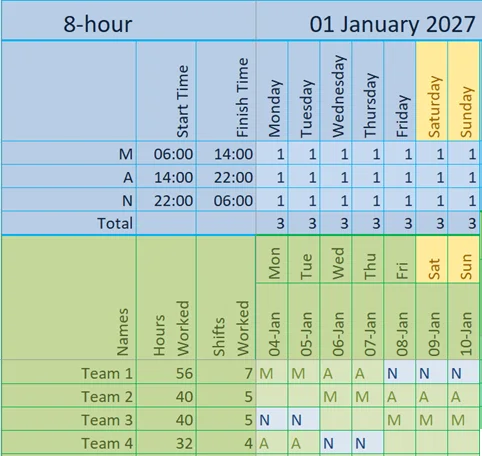
Week in the standard 2‑3‑2 8‑hour shift pattern, showing how four teams provide continuous 24/7 coverage with a 42‑hour average working week.
The 2‑3‑2 8‑Hour Pattern and the 40‑Hour Rule
One of the most widely used 8‑hour shift patterns in 24/7 operations across the UK and Europe is the 2‑3‑2 pattern. It’s popular because it provides predictable rest, whole weekends off, and a fair rotation of days, nights, and weekends — all while delivering continuous coverage with just four teams.
But this pattern also highlights a major difference between European and American scheduling: the 40‑hour rule.
How the 2‑3‑2 Pattern Works
The 2‑3‑2 pattern runs over a four‑week cycle:
Week 1 — 56 hours
The team works seven consecutive 8‑hour shifts (56 hours).
This is what makes the pattern work: it provides full coverage with only four teams.
Week 2 — 40 hours
They work Wednesday to Sunday (five shifts).
Week 3 — 40 hours
They work Monday–Tuesday, then Friday–Sunday.
Week 4 — 32 hours
They work Monday–Thursday, then have the weekend off.
Across the full cycle, the average is 42 hours per week, which is typical for 24/7 operations in the UK and Europe. Workers get:
- one full weekend off every four weeks
- two or three consecutive days off after 7-consecutive shifts
- predictable rotation
- manageable fatigue
- fair distribution of nights and weekends
It’s a well‑balanced pattern — but it cannot be used in the United States.
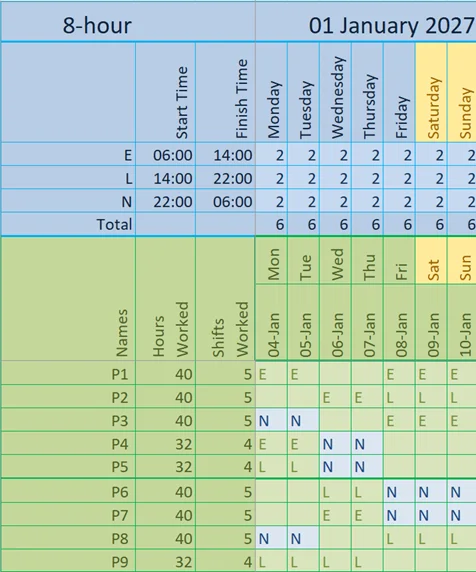
Week in the 40‑hour‑compliant version of the 2‑3‑2 pattern, showing how nine people provide 24/7 coverage while keeping every individual under 40 hours per week.
The Difference: 42‑Hour vs 37‑Hour Weeks
When you compare the main 8‑hour patterns used in 24/7 operations, a clear tension emerges between coverage, simplicity, weekly hours, and earnings. The standard 2‑3‑2 pattern is extremely efficient: it only needs eight people to provide two‑person 24/7 coverage, it gives whole weekends off, and it delivers a predictable rhythm that workers understand. But it also includes a 56‑hour week, which makes it incompatible with the U.S. 40‑hour rule.
The American alternative — the 40‑hour‑compliant version — solves the legal problem but introduces new ones. It requires an extra person, and extra people are expensive: hiring, training, uniforms, equipment, and ongoing overheads. It also reduces earnings. Staff on the 37‑hour week earn around 13% less than those on the 42‑hour pattern, meaning some may need additional income to make up the difference. Operationally, the pattern is less regular, harder to run, and lacks the simplicity people prefer.
Yet despite their differences, these two patterns have a lot in common. They are both 8‑hour schedules. They both involve up to seven consecutive shifts. And they both offer whole weekends off, which is a major advantage in any 24/7 operation.
So the question becomes:
Is there an 8‑hour pattern that brings together the best of both worlds — fewer staff, simplicity, and a working week close to 40 hours with only limited overtime?
One possibility is the 6‑on shift pattern.
The 8‑Hour 6‑On Shift Pattern
Another common 8‑hour pattern used in 24/7 operations is the 6‑on shift pattern. It uses eight people to provide two‑person coverage 24/7, making it structurally similar to the 2‑3‑2 pattern but simpler to run and easier to understand.
The name comes from its core rhythm:
Six consecutive shifts followed by two days off.
This creates an 8‑week repeating cycle that is predictable, easy to manage, and highly effective from a fatigue point of view.
Weekly Hours and Overtime
Most weeks in the cycle are 40‑hour weeks, which makes the pattern attractive for American operations. However, there are two weeks where individuals work 48 hours, creating:
- 16 hours of overtime across the 8‑week cycle
- an average weekly total of 42 hours
This is higher than the 37‑hour average seen in 40‑hour‑compliant patterns, meaning staff on the 6‑on pattern would earn around 15% more because they are on a 40-hour week and have two hours of overtime per week. For many workers, this is a significant and welcome compensation for the restrictive nature of the pattern.
Fatigue and Recovery
From a fatigue perspective, the 6‑on pattern performs surprisingly well:
- The six shifts are broken up by natural 24‑hour breaks as the pattern rotates from earlies → lates → nights.
- These transitions reduce cumulative fatigue because each shift change introduces a full day’s rest.
- The only notable fatigue challenge is the two days off after nights, which are spent recovering before returning to earlies.
Despite this, the pattern is considered fatigue‑friendly compared to many other 8‑hour rotations.
The Downside: Split Weekends
The main drawback is the weekend structure:
- Seven out of eight weekends are split — staff work either one or both weekend shifts.
- On the one weekend they are fully off, they finish on Friday night, which limits usable rest time.
This makes the pattern less attractive for workers who value full weekends off, but it remains popular in industries where continuous coverage is essential and overtime budgets allow for occasional 48‑hour weeks.
Why the 2‑3‑2 Pattern Doesn’t Work in the U.S.
Under the Fair Labor Standards Act (FLSA), any hours worked over 40 in a single week must be paid at overtime rates. While shift workers could theoretically be exempt, in practice almost all shift workers are non‑exempt, meaning the 40‑hour rule applies.
This makes the 2‑3‑2 pattern impossible to use in American operations because:
- Week 1 is 56 hours
- Week 2 is 40 hours
- Week 3 is 40 hours
- Week 4 is 32 hours
The first week alone triggers 16 hours of overtime, every cycle, for every worker.
Most U.S. organisations cannot sustain that cost. This is why the 2‑3‑2 pattern — despite being one of the most effective 8‑hour 24/7 patterns — is almost never used in the United States.
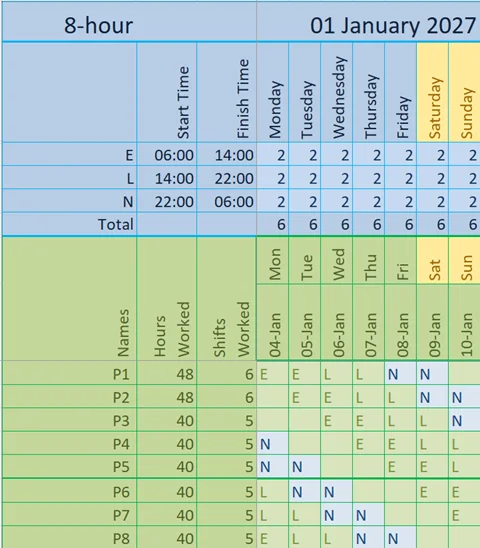
One week of the 8‑hour 6‑on shift pattern, showing how eight people provide two‑person 24/7 coverage with a simple six‑shifts‑on, two‑days‑off rotation.
Comparison: 2‑3‑2 vs 40‑Hour‑Compliant vs 6‑On 8‑Hour Patterns
These three patterns all provide continuous 24/7 coverage using 8‑hour shifts, but they behave very differently depending on whether the organisation must comply with the U.S. 40‑hour rule.
The 2‑3‑2 Pattern (UK/Europe)
The 2‑3‑2 pattern is one of the most efficient 8‑hour 24/7 patterns. It gives whole weekends off, predictable rotation, and a manageable fatigue profile. But because Week 1 is 56 hours, it cannot be used in the U.S. without triggering overtime every cycle. This is why it remains popular internationally but is almost never seen in American operations.
The 40‑Hour‑Compliant Version (U.S.)
To avoid overtime, the pattern must be redesigned so no week exceeds 40 hours. This requires nine people instead of four teams, and delivers an average 37‑hour week. It still allows up to seven consecutive shifts, but workers earn less than in the 42‑hour version — around 13% less at basic rate. Operationally, it is compliant and effective, but more expensive in staffing numbers.
The 6‑On Pattern
The 6‑on pattern is simple, predictable, and surprisingly fatigue‑friendly. Most weeks are 40 hours, with two 48‑hour weeks creating 16 hours of overtime across the 8‑week cycle. Workers earn around 15% more than those on 37‑hour compliant patterns. The downside is split weekends — seven out of eight weekends involve working one or both days. Still, it is a practical compromise for organisations that can accommodate occasional overtime.
The table below summarises the key differences.
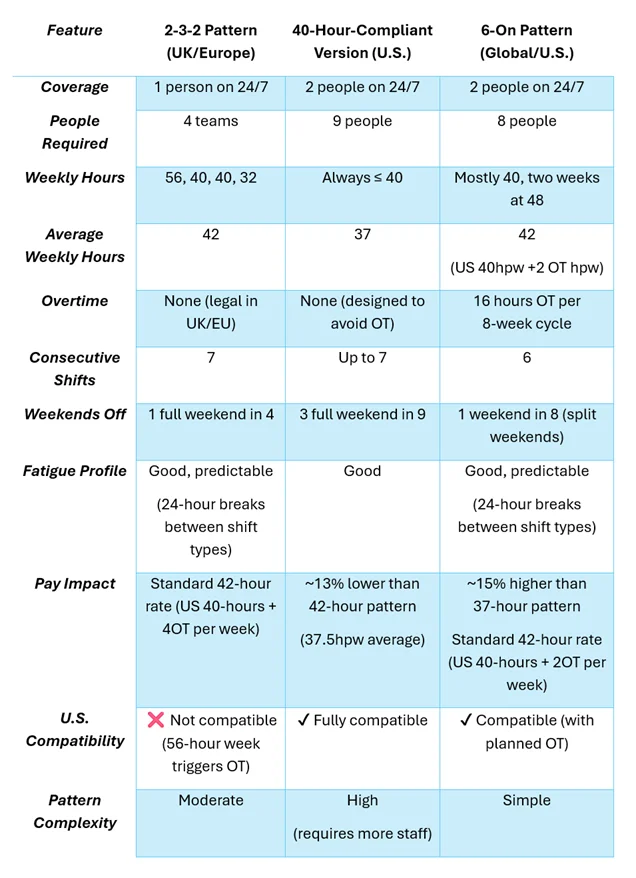
These example have the week starting Monday 6am. Other starting times would produce slightly different results.
We often use 12-hour and 10-hour schedules when matching workloads (i.e. 2x12h + 2x8h=40h)
Case Study: The “Work Every Day” Schedule — A Unique American Challenge
Every so often, a company approaches us with a challenge so unusual that it reshapes the way we think about scheduling. One American organisation came to us with exactly that kind of problem. They wanted to give their employees the option to work every single day of the year if they chose to. Not because they expected people to do it, but because they wanted to offer complete flexibility — a system where staff could decide for themselves when to take time off, without restrictions, rules, or forced rotations.
Their difficulty was simple to describe but incredibly complex to solve. Employees needed to be able to move from days to nights, and then back again, without being forced to take a day off. But if people could choose their own days off freely, how do you maintain fairness? How do you ensure the pattern doesn’t trap someone on nights forever? And how do you build a structure that works 365 days a year, without collapsing under its own flexibility?
They wanted a shift pattern — a single, elegant solution that made the impossible possible. So we worked with them through our consultancy service to design something completely unique: a 365‑day shift pattern where an employee could, if they wished, work every day of the year. No mandatory days off. No forced rotations. No artificial limits. A pattern that allowed full freedom while still maintaining operational stability.
And here’s the interesting part. Once the pattern was built and implemented, we analysed how people actually used their freedom. Despite having the option to work every day, nobody did. Instead, employees naturally settled into a rhythm:
- most took two days off together on a regular basis
- many took two weeks off in the summer
- people took time off around Christmas and other holidays
- the pattern gave them freedom, but they used it sensibly
The company didn’t want to encourage people to work every day — they simply wanted the option to exist. They wanted a system that respected personal choice, supported individual circumstances, and removed the feeling of being “locked” into a rota.
What we delivered was a pattern that gave them exactly that: complete flexibility, complete fairness, and complete coverage — all in one design.
It remains one of the most unusual and innovative shift patterns we’ve ever created, and a perfect example of how bespoke scheduling can solve problems that standard patterns simply cannot touch.
Compliance & Fairness for U.S. Operations
We supports American organisations by ensuring:
- FLSA compliance
- Overtime avoidance
- Predictable scheduling (important in many states)
- Fair distribution of nights and weekends
- PTO visibility
- Fatigue‑aware scheduling
- Skill coverage at all times
- Matching staffing levels to workload
Our expertise lies in designing shift patterns that work for people. We take every constraint you face: workload, staffing levels, fatigue, fairness, holidays, skills, and operational demands. We use them to create a pattern that not only matches the workload but genuinely works for your employees and your managers. The result is a shift system that removes day‑to‑day scheduling problems, frees managers from constant firefighting, and allows them to focus on doing their best work.
Training & Support for U.S. Teams
You can get started in minutes with our Shift Scheduling Course, which includes:
- Step‑by‑step video guides
- A downloadable copy of VisualrotaX
For a more comprehensive course see our Managing Shift Operations option, which includes:
- the Shift Scheduling Course
- Practical examples of American staffing schedules
- Guidance on PTO, cover rules, banked hours, and day‑to‑day operations
If you use our consultancy services, VisualrotaX is included. If you’ve had a Business Health Check, you receive a complimentary copy, fully set up with your staffing schedule and ready to run.
Follow‑the‑Sun
Many of our international clients operate across multiple time zones, with teams spread around the world who need to work seamlessly together. We support these organisations in designing follow‑the‑sun shift patterns: systems where each region hands over smoothly to the next, ensuring 24‑hour coverage while allowing every team to work only during their local daytime hours.
This approach reduces fatigue, improves communication, and creates a more sustainable way of working for global operations. Whether it’s coordinating sites across continents, aligning customer support teams worldwide, or ensuring critical information is passed on without delay, we help international organisations build shift systems that are fair, efficient and resilient.
The companies here represent just some of the global organisations who trust us to support their workforce planning, shift pattern design and operational change across borders.
If you would like to find out more about our clients, please follow this link.
Ready to Build a Better Staffing Schedule?
If you’re ready to design a staffing schedule that matches your workload, supports your people, and keeps your operation compliant, you can get started today with our Shift Scheduling Course. It includes VisualrotaX, video guides, and real examples to help you run your staffing schedule with confidence.
We’d be delighted to help you take the next step.
If you’re facing challenges with staffing, fairness or shift design, we can guide you through the next steps. Contact us to explore how we can support your operation.
Email: alec@visualrota.co.uk